Kinesthetic awareness is your sense of where your body is and how it is moving without looking. Receptors in muscles, tendons, joints and skin feed it, and researchers mostly treat it as the same thing as proprioception. Clinicians test it with tasks like the Romberg test, and it tends to dull with age, which matters for falls.
Listen to this article, about 12 minutes. A synthetic voice reads the article and announces each section title as it begins; tables are read row by row and the questions at the end are left out.
Recorded 9 November 2026 from the article as published that day. Press a chapter to jump there; the highlighted line is what is playing. A play button sits beside every section heading, and once you scroll past this player a bar at the bottom of the screen keeps the controls in reach. Tap or click any sentence to hear the reading start from there.
On this page: a table of five tests of body sense with what the person does in each, the CDC fall rates for three age bands from a survey of 147,319 older adults, what a 51 study review and a 108 trial Cochrane review found, and accounts from two Reddit threads on clumsiness and falls.
Think you already know this? Five questions, one minute.
Every answer is on this page. Answer from what you know now; the page fills in the rest.
-
1. Who coined the word kinaesthesia, according to the 2009 review by Proske and Gandevia?
The review credits the British neurologist Henry Bastian, who used it for the sense of the position and movement of the limbs and trunk. Proske and Gandevia, 2009 Read the section
-
2. How many different tools for measuring proprioception did the 2015 systematic review find?
Hillier, Immink and Thewlis kept 57 of 935 articles and found 32 tools or methods, most with poorly evaluated reliability. Hillier and colleagues, 2015 Read the section
-
3. Which part of body sense did the 2015 review say declines with age most consistently?
It concluded that joint position sense acuity decreases with age, while movement sense declines are less consistent and depend on the task. Frontiers in Human Neuroscience, 2015 Read the section
-
4. In the CDC survey of 2014, what share of adults aged 85 and over reported a fall in the past year?
The share rose with age, from 26.7% at 65 to 74 to 36.5% at 85 and over, among 147,319 adults surveyed. CDC MMWR, 23 September 2016 Read the section
-
5. By how much did balance and functional exercise cut the rate of falls in the 2019 Cochrane review?
A rate ratio of 0.76 from 39 studies and 7,920 people, rated high certainty evidence. Cochrane review by Sherrington and colleagues, 2019 Read the section
What is kinesthetic awareness?
Close your eyes and touch your nose. You probably managed it, and nothing told you where your hand was. That quiet bit of knowing is kinesthetic awareness. In British spelling it is kinaesthetic, and the science papers use both.
The British neurologist Henry Bastian coined it in the late 1880s, from the Greek for move and sensation, and a 2009 review in the Journal of Physiology by Uwe Proske and Simon Gandevia still uses his sense of it: the ability to sense the position and movement of our limbs and trunk. Their later review in Physiological Reviews widens the family to the sense of effort, of force and of heaviness, and notes that the receptors involved sit in skin, muscles and joints.
The wellness posters that call it a secret sixth sense are overselling slightly. It is less mystical than that, and more useful.
Is kinesthesia the same thing as proprioception?
Mostly, yes. In 1906 the physiologist Charles Sherrington coined proprioception, from the Latin for one’s own, for the information from receptors in joints, muscles and tendons that lets a person know where their body parts are. The 2016 review by Jia Han and colleagues in the Journal of Sport and Health Science notes that different specialties draw the line between the two words differently, and that many researchers now treat them as synonyms.
Where a line is drawn, kinesthesia leans towards movement and proprioception covers position as well. Neither is the same as balance, which also draws on the eyes and the inner ear. And neither is the same as the broader idea of awareness in psychology, which is about what your attention picks up from the world rather than from your own limbs.
How do clinicians and researchers test it?
There is no single kinesthetic awareness test, and that is the first honest thing to say about it. A 2015 systematic review by Hillier, Immink and Thewlis screened 935 articles, kept 57, and found 32 different tools for measuring proprioception, most of them with their reliability poorly evaluated or reported. The table below lists the ones that come up most, with what the person being tested actually does. The names are for recognising them on a clinic letter, not for trying at home.
| Test | What the person does | What it measures | Source |
|---|---|---|---|
| Romberg test | Stands with feet together, first with eyes open, then with eyes closed | Whether standing balance holds once vision is taken away, which leans on proprioception | StatPearls |
| Threshold to detection of passive motion | Sits or lies still while a machine moves one joint very slowly, and presses a button the moment they feel it move and can say which way | Movement sense: the smallest movement that can be felt | Han and colleagues, 2016 |
| Joint position reproduction, or joint position matching | Has a joint placed at an angle, then tries to put it back there, or match it with the other limb, without looking | Position sense: the error, in degrees, between target and attempt | Han and colleagues, 2016 |
| Active movement extent discrimination | Moves a joint to physical stops of slightly different sizes and says which one each was | How finely the person can tell similar movements apart | Han and colleagues, 2016 |
| Rivermead Assessment of Somatosensory Perception | A standardised bedside battery of touch and position tasks used in rehabilitation | Several body senses together; rated valid and reliable, with low precision | Hillier and colleagues, 2015 |
Han and colleagues point out that the three laboratory methods arguably measure different parts of the sense, and that their conditions, with slow passive movements and the body strapped down, look little like real life. StatPearls treats a positive Romberg result as a reason for further assessment, not a diagnosis.
One finding they cite is close to this site’s home ground. When attentional demands were increased, ankle proprioception got worse in healthy young adults. Your body sense, it seems, shares a budget with everything else you are thinking about, which may be why the stairs feel steeper while answering a message. The same tug between attention and speed shows up in simple reaction time.
Does kinesthetic awareness change with age?
It tends to, though the size of the change depends on what is measured. A 2015 review in Frontiers in Human Neuroscience concluded that joint position sense acuity decreases with age, while declines in movement sense are less consistent and depend on the task and on how many joints move. A 2007 review in the European Review of Aging and Physical Activity by Ribeiro and Oliveira describes the decline as involving both the nerves and the brain, links it to balance problems and falls, and reports one study where older people needed about 50% more knee movement before they could detect it.
These are group averages from research samples, not a description of any one person’s knees.
How common are falls in older adults?
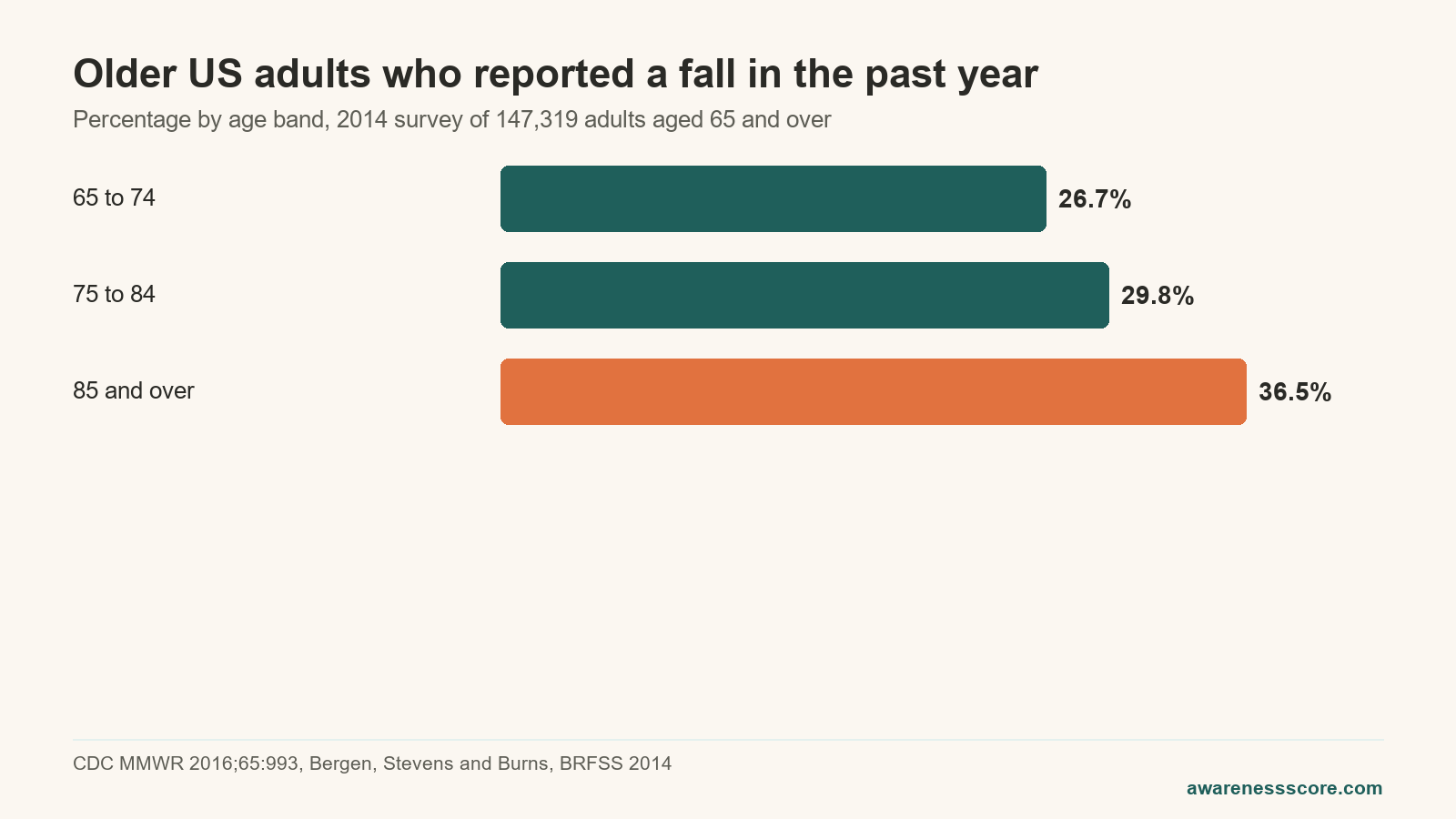
Falls are where this sense stops being a curiosity. The US Centers for Disease Control and Prevention reported in its MMWR of 23 September 2016, from a 2014 survey of 147,319 adults aged 65 and over, that 28.7% had fallen at least once in the previous year, an estimated 29.0 million falls. The share rose with age: 26.7% at 65 to 74, 29.8% at 75 to 84 and 36.5% at 85 and over. About 37.5% of those who fell had a fall that needed medical treatment or limited their activity.
The UK figures run along the same lines. NHS England says more than one in three people over 65 fall each year. Both are survey figures for whole populations, and say nothing about any single reader’s risk.
Proprioception is only one strand. The NHS falls page, last reviewed on 6 March 2025, lists muscles weakening with age, conditions that affect balance, low blood pressure, side effects of some medicines, eyesight or hearing problems and dementia among the causes.
What did the training studies actually find?
Every so often an advert promises that a wobble cushion will rewire your brain by the weekend. The research is more modest, and more interesting. A 2015 systematic review in Frontiers in Human Neuroscience by Aman, Elangovan, Yeh and Konczak screened 1,284 articles and kept 51 studies. About half, 26 of the 51, used active movement or balance training. Across all outcome measures, training produced an average improvement of 52%, measured as change from before to after.
The caveats are large, and the authors say so. Twenty of the 51 studies had no comparable control group, most were small, stroke was the most studied condition, and the authors call their conclusions “preliminary in nature”. A before and after gain without a control group can include plain practice at the test, the same problem we found with brain training apps.
The stronger evidence is about falls, not about the sense itself. The 2019 Cochrane review by Sherrington and colleagues pooled 108 randomised trials with 23,407 people living in the community. Exercise cut the rate of falls by 23% (rate ratio 0.77, from 59 studies and 12,981 people), and balance and functional exercise by 24% (0.76, from 39 studies and 7,920 people), both rated high certainty. Cochrane’s summary adds that the effect was larger where a health professional, usually a physiotherapist, delivered the programme.
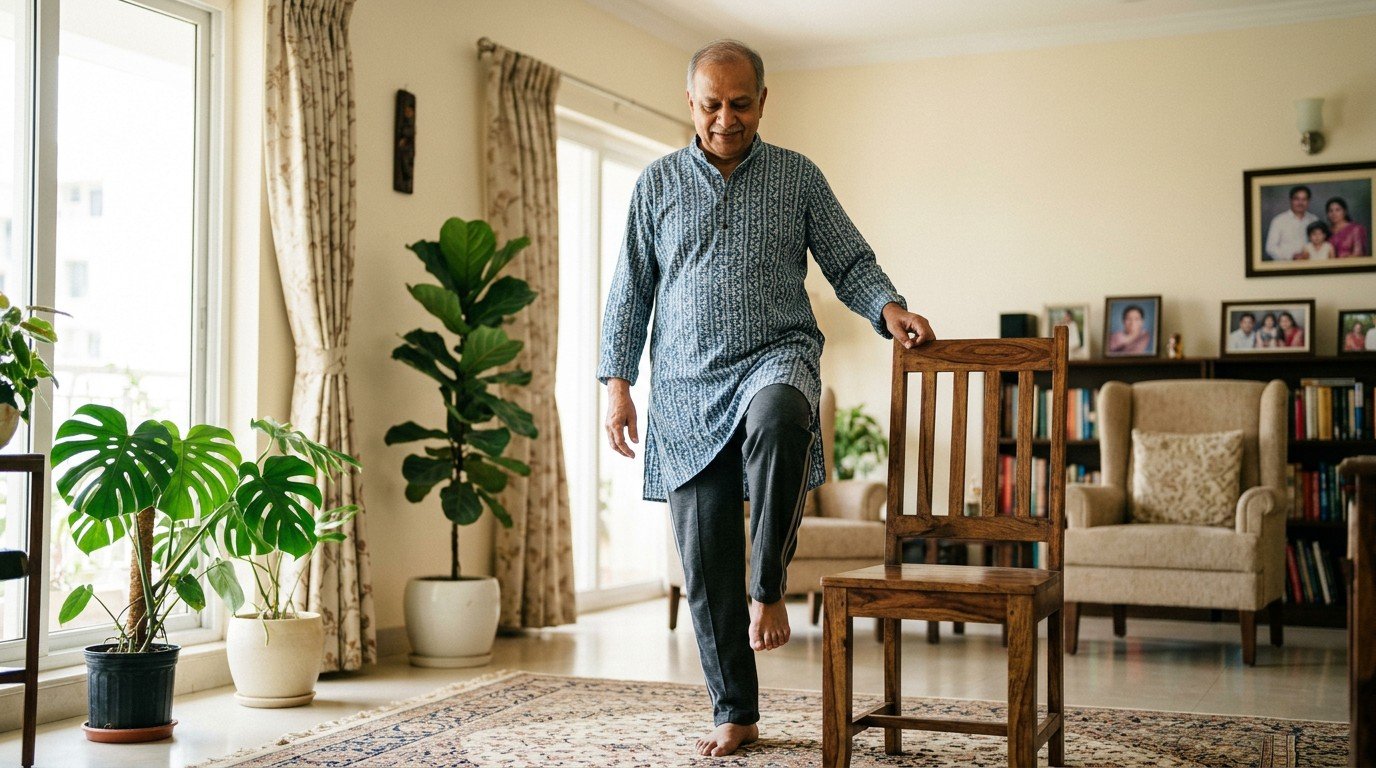
What did those programmes look like? One registered trial of the Otago home programme in women aged 65 and over, NCT05931848 on ClinicalTrials.gov, lists twelve balance exercises, from knee bends and walking backwards to standing on one leg and stairs. The trial was later terminated, so the checklist below records what it planned, not a programme for anyone to follow.

The balance exercises one registered Otago trial listed
Each item restates an exercise named in trial NCT05931848 on ClinicalTrials.gov, for women aged 65 and over. It is a record of what the trial planned, not a programme, and it scores nothing about you. The trial was terminated before completion.
Copied from the trial record on ClinicalTrials.gov, read on 9 November 2026. If you are thinking about balance exercise, a GP or physiotherapist is the person to ask. Ticks are saved on this device only.
What do people who call themselves clumsy report?
For this section we read two public Reddit threads: one from r/AgingParents in December 2025 with 33 replies, and one from r/adhdwomen in February 2026 with 28. These are what people report about themselves and their families. They are testimony, not evidence.
In the February 2026 thread, a poster in their thirties wrote about a lifetime of falling on stairs and walking into door frames, and used the word proprioception for it. Many replies said they had never known the clumsiness had a name. Several described the same pattern: falls came when they were carrying something, distracted or talking, and things went better when they held the rail and watched each step.
The December 2025 thread came from someone whose mother kept falling despite assisted living and a spell of rehabilitation. Several replies said progress faded once the physiotherapy ended and the exercises stopped. Others pointed to causes beyond the legs: medicines, blood pressure, eyesight.
These accounts match the evidence in shape: attention matters, falls rarely have one cause, and exercise with a professional seems to count. Where they name conditions or fixes, they are opinions.
When is a change in balance worth a doctor’s visit?
The NHS falls page is clear on this. Call 999 if someone has fallen and may have injured their head, back, neck or hip, or cannot get up. Get help from 111 if they may be in pain, injured or unwell after a fall. See a GP if you are worried about your balance or mobility, or you have had a fall. A GP may check balance and refer to a specialist falls service, which can look at muscle strength, bones and eyesight.
A new numbness, tingling or unsteadiness, or a change in how your body feels that worries you or the people around you, is worth raising with a doctor too. No article and no app can tell you what it means.
If what you want is simply to see how your own attention and reaction time drift across ordinary days, the free Awareness Score check-in takes about five minutes and compares you only with your own earlier check-ins. It does not test balance or proprioception, it is not a diagnosis or a medical test, and scores move with practice, sleep, stress and the time of day. For the inward kind of awareness, our page on what self awareness means is the next stop.
Frequently asked questions
Is kinaesthetic awareness spelt with an a?
In British English it is usually kinaesthetic, and in American English kinesthetic. Both spellings appear in the research and mean the same thing.
Who coined the word kinesthesia?
The British neurologist Henry Bastian, in the late 1880s. Charles Sherrington introduced proprioception in 1906.
Is kinesthetic awareness the same as balance?
No. Balance draws on body sense, vision and the inner ear together. Kinesthetic awareness is one of those inputs.
What does a positive Romberg test mean?
StatPearls describes it as a sign that standing balance fails once vision is removed, and as a reason for further assessment by a clinician rather than a diagnosis in itself.
How many tests of proprioception are there?
A 2015 systematic review by Hillier and colleagues found 32 different tools or methods described across 57 articles.
Is a kinesthetic learner the same thing?
No. Kinesthetic learning is an idea from learning styles, about preferring hands on activity. It is unrelated to the body sense described in the physiology papers.
Finished the page? The same five questions from the top, to see what stuck.
General information from published research and public health bodies, checked on 9 November 2026. It is not medical advice, and the Awareness Score app is not a medical test. If your memory or thinking has changed noticeably, or worries you or the people close to you, talk to your doctor.
Leave a Reply