
Mental health, in the WHO’s words, is “a state of mental well-being” that lets people cope with the stresses of life, realise their abilities, learn and work well, and contribute to their community. It is not the same as having no mental illness: the WHO places it on a continuum, and conditions are one part of that picture.
Listen to this article, about 12 minutes. A synthetic voice reads the article and announces each section title as it begins; tables are read row by row and the questions at the end are left out.
Recorded 5 November 2026 from the article as published that day. Press a chapter to jump there; the highlighted line is what is playing. A play button sits beside every section heading, and once you scroll past this player a bar at the bottom of the screen keeps the controls in reach. Tap or click any sentence to hear the reading start from there.
On this page: the WHO, ICD-11, NIMH and Warwick definitions quoted side by side in one table, the 2023 WHO figures, the continuum study of 3,032 adults, and what 68 forum comments say good mental health feels like.
Think you already know this? Five questions, one minute.
Every answer is on this page. Answer from what you know now; the page fills in the rest.
-
1. How does the WHO fact sheet dated 11 September 2026 describe mental health?
The fact sheet calls it a state of mental well-being that enables people to cope, realize their abilities, learn and work well, and contribute to their community. WHO mental health fact sheet Read the section
-
2. Which term does the WHO call the broader one?
The WHO says mental health condition is a broader term covering mental disorders, psychosocial disabilities and other mental states with significant distress, impairment or risk of self-harm. WHO mental disorders fact sheet Read the section
-
3. In Keyes’s 2002 study of 3,032 adults, what share fitted the criteria for flourishing?
17.2% were flourishing, 56.6% moderately mentally healthy and 12.1% languishing, in a 1995 sample of American adults. Keyes 2002 Read the section
-
4. How many people does the WHO say were living with a mental disorder in 2023?
The WHO mental disorders fact sheet gives nearly 1 in every 7 people, 1.2 billion, in 2023, with anxiety and depressive disorders the most common. WHO mental disorders fact sheet Read the section
-
5. What does the 2007 WEMWBS paper say the scale offers promise for?
Tennant and colleagues wrote that the 14 item scale offers promise as a tool for monitoring mental well-being at a population level. Tennant and colleagues, 2007 Read the section
How does the WHO define mental health?
Search the phrase and you get a wall of listicles, each promising to explain mental health in seven tips, most of them involving a bath. The definition everyone is paraphrasing is shorter than any of them. The WHO fact sheet on mental health, dated 11 September 2026 and read for this page on 5 November 2026, says mental health “is a state of mental well-being that enables people to cope with the stresses of life, realize their abilities, learn and work well, and contribute to their community.”
Two sentences later it adds the part most summaries leave out: “Mental health exists on a complex continuum, which is experienced differently from one person to the next.”
The idea is older than the fact sheet. The WHO Constitution, in force since 1948, defines health as “a state of complete physical, mental and social well-being and not merely the absence of disease or infirmity.” Notice what both definitions describe: coping, learning, working, contributing. What a person can do, not a feeling they must hold every day.
Mental health, mental illness, mental disorder: what is the difference?
The words get used as if they were swappable. In the public health bodies’ own pages they are not. Here they are side by side, quoted, with the source on every row.
| Term | Who defines it | In their words | Source |
|---|---|---|---|
| Mental health | WHO | “a state of mental well-being that enables people to cope with the stresses of life, realize their abilities, learn and work well, and contribute to their community” | WHO fact sheet, 2026 |
| Health (the parent idea) | WHO Constitution | “a state of complete physical, mental and social well-being and not merely the absence of disease or infirmity” | WHO Constitution |
| Mental health condition | WHO | Covers “mental disorders and psychosocial disabilities as well as other mental states associated with significant distress, impairment in functioning, or risk of self-harm” | WHO fact sheet, 2026 |
| Mental disorder | WHO | “a clinically significant disturbance in an individual’s cognition, emotional regulation, or behaviour”, usually with distress or impairment | WHO fact sheet, 2026 |
| Mental, behavioural or neurodevelopmental disorders | ICD-11, chapter 06 | “syndromes characterised by clinically significant disturbance in an individual’s cognition, emotional regulation, or behaviour” | Copy of the chapter entry |
| Any mental illness | NIMH | “a mental, behavioral, or emotional disorder” | NIMH statistics |
| Mental wellbeing | WEMWBS team, Warwick | “the positive aspect of mental health, encompassing feeling good and functioning well” | Warwick WEMWBS page |
Read down the table and a pattern appears. Mental health is the broad state everyone has, good or poor. A mental health condition is the WHO’s wide umbrella, and the WHO mental disorders fact sheet calls it “a broader term” than mental disorder. A mental disorder is the narrow clinical category, defined almost word for word the same way in ICD-11, the WHO’s diagnostic classification. Mental illness is the everyday and American word; NIMH uses “any mental illness” in its statistics for the same idea.
None of them defines mental health as the absence of a disorder. And a diagnosis is made by a clinician in a consultation; nothing on this page is a way to make one at home.
Which term did you mean? Read the definition and its source
Pick a term to read how a public health body or the researchers who use it define it, with the link. This is a glossary. It does not assess, score or describe anyone’s own mental health.
Definitions quoted from the linked pages, read on 5 November 2026. Not medical advice.
Can someone have a mental health condition and good mental health?
Yes, and that is the point of the word continuum. The best known research version comes from the sociologist Corey Keyes, whose 2002 paper in the Journal of Health and Social Behavior treated mental health as a set of positive feelings and positive functioning, measured separately from illness. He called the top of that scale flourishing and the bottom languishing. A 2019 survey of 10,012 New Zealand adults that used a flourishing scale found wellbeing rose with each extra habit people practised, which our page on mental wellbeing and the Five Ways to Wellbeing covers in full.
Applied to 3,032 American adults aged 25 to 74 in the 1995 Midlife in the United States study, the paper reported that 17.2% fitted the criteria for flourishing, 56.6% were moderately mentally healthy and 12.1% were languishing. Separately, 14.1% met criteria for a major depressive episode in the past year: 9.4% of the sample had that without languishing, and 4.7% had both. So some people with depression still scored well on positive functioning, and some with no disorder were languishing. These figures describe one 1995 sample, not any reader.

The paper also found the risk of a major depressive episode was about two times higher among languishing adults than among the moderately healthy, and nearly six times higher than among the flourishing. That is an association in a survey, not a prediction for a person. The WHO adds that “no single factor can reliably predict mental health outcomes.”
How many people live with a mental health condition?
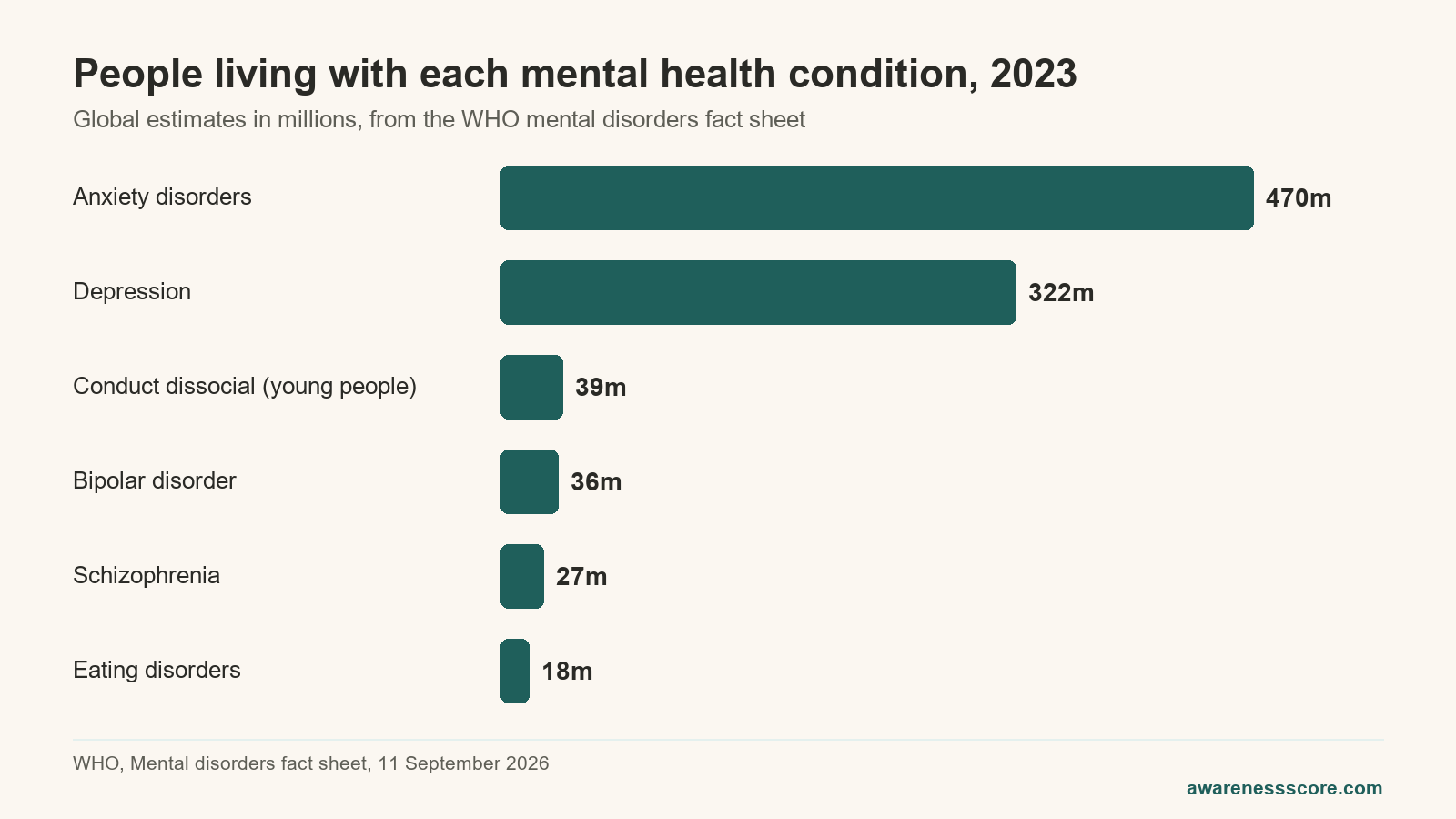
Lots, and the headline number has grown as the estimates have been updated. The WHO mental disorders fact sheet says that in 2023 “nearly 1 in every 7 people (1.2 billion) around the world were living with a mental disorder”, with anxiety and depressive disorders the most common. Many older pages still quote 1 in 8, the figure commonly cited for 2019, so check the year beside any number.
The same fact sheet gives 470 million people living with an anxiety disorder in 2023, 322 million with depression, 39 million children and adolescents with conduct dissocial disorder, 36 million with bipolar disorder, about 27 million with schizophrenia and 18 million with eating disorders. These are global population estimates and say nothing about any one person.
In India, the National Mental Health Survey of 2015 to 16, run by NIMHANS across 12 states with 34,802 interviews, estimated a lifetime prevalence of any mental morbidity of 13.67% and a current prevalence of 10.56% among adults. It put the treatment gap at 84.5%, meaning most people with a condition were not receiving care. In the United States, NIMH reports that 23.1% of adults, 59.3 million people, lived with any mental illness in 2022, and that 50.6% of them received treatment in the past year. The surveys used different methods, so the percentages are not a league table.
How do researchers measure mental wellbeing?
Not with a six question quiz that tells you what you have. The research tools for wellbeing are short questionnaires used to track groups of people over time, and their makers are careful about what they claim.
The Warwick Edinburgh Mental Wellbeing Scale, described by Tennant and colleagues in 2007, has 14 positively worded statements. The paper says it “offers promise as a tool for monitoring mental well-being at a population level” and reports a one week test retest reliability of 0.83. The Warwick WEMWBS page also offers a 7 item version, under licence.
The WHO-5 Well-Being Index is even shorter: five questions. A systematic review by Topp and colleagues in 2015 covered 213 articles and found it valid as an outcome measure in clinical trials and as a screening tool for depression. Screening there means a first step used by researchers and clinicians, followed by an assessment, not a verdict.
This site does not offer either questionnaire, and it does not score anyone’s mental health. The Awareness Score app at the domain root is something smaller and different: four short games on attention, memory and reaction time, with a 0 to 100 score compared only with your own earlier check-ins. It is not a diagnosis or a medical test, scores rise a little with practice, and they move with sleep, stress and time of day. If you want to see how those games go across a week, the check-in takes about five minutes.
What do people say good mental health feels like?
The definitions are tidy. To hear how people describe the thing itself, this page read four public Reddit threads from 2026, 68 comments in all. What follows is testimony, labelled as such, and not a finding about anyone.
In a June 2026 r/NoStupidQuestions thread asking how many people are truly mentally healthy, the most upvoted reply, from someone describing themselves as a psychology student, said it depends on the definition: under a strict no defect standard nobody qualifies, while a functional standard counts many more. Others pushed back on the word truly; one said most people get along okay.
A May 2026 r/RandomThoughts thread argued that people read an approachable face and a lively voice as good mental health. Several of the 18 replies disagreed: one said that describes a good mood, not mental health, and another said they come across as lively while struggling privately.
Asked in a September 2026 r/AskReddit thread what very good mental health feels like, replies used words such as peaceful, stable and relief. Several said they had never felt it, or could not remember when they had. In a short August 2026 r/mentalhealth thread, one person described two years of asking themselves whether they were okay, swinging between thinking they were minimising and thinking they were overreacting.

Where the accounts match the bodies: people describe good mental health as coping and functioning, not as constant happiness, and several say it can sit alongside a diagnosis, as the continuum says. Where they differ: many treat it as all or nothing, something you have or lack, which is exactly what the WHO’s continuum sentence argues against.
Where is help if mental health is getting worse?
If mood, worry or thinking has changed in a way that troubles you or the people close to you, talk to your doctor. Nothing on this page, and no score from any app, replaces that conversation. This site’s pages on the signs of depression the public health bodies list and the signs of anxiety they list quote those lists in full, and the page on counsellors, psychologists and psychiatrists sets out who does what.
In India, Tele-MANAS answers on 14416 or 1800 891 4416, free and round the clock, in about 20 languages; the numbers were confirmed again on 5 November 2026, and the Tele-MANAS site is the service’s own page. In the United States, the 988 Suicide and Crisis Lifeline answers calls and texts on 988, and 911 is for a life threatening emergency. In the UK, the NHS urgent help page says to call 111 and choose the mental health option, lists Samaritans on 116 123, and says to call 999 or go to A&E in an emergency.
The yearly day for all of this is covered on the page about World Mental Health Day. Mufy Pachorawala, who writes these pages and runs the Awareness Score app, is not a doctor or a psychologist, which is why every definition above is quoted and linked to the body that published it.
Frequently asked questions
Is mental health the same as mental illness?
No. The WHO defines mental health as a state of mental well-being. Mental illness, or a mental disorder, is a clinically significant disturbance in thinking, emotional regulation or behaviour. A person can have one without the other.
What did the WHO change in its mental health figures?
The WHO mental disorders fact sheet dated 11 September 2026 gives nearly 1 in 7 people, 1.2 billion, living with a mental disorder in 2023. Many older pages still quote 1 in 8, the earlier figure for 2019.
What is languishing?
Languishing is the term Corey Keyes used in 2002 for the low end of positive mental health, low positive feelings and functioning, measured separately from mental illness.
Is the WHO-5 a test I can use to diagnose myself?
No. The WHO-5 is a five question wellbeing questionnaire used in research and clinical settings. A positive screen is followed by a clinical assessment; it is not a diagnosis.
What does the ICD-11 call mental disorders?
ICD-11 chapter 06 is mental, behavioural or neurodevelopmental disorders, described as syndromes with clinically significant disturbance in cognition, emotional regulation or behaviour.
Does the Awareness Score app measure mental health?
No. It is four short games on attention, memory and reaction time, with a score compared only with your own earlier check-ins. It is not a diagnosis or a medical test.
Finished the page? The same five questions from the top, to see what stuck.
General information from published research and public health bodies, checked on the date shown. It is not medical advice, and the Awareness Score app is not a medical test. If your memory or thinking has changed noticeably, or worries you or the people close to you, talk to your doctor.
Leave a Reply