
Mental wellbeing means feeling good and functioning well, the definition used by the 2008 report behind the Five Ways to Wellbeing. Its five actions are connect, be active, take notice, keep learning and give. Later studies link each to modestly higher wellbeing, some through experiments and many through surveys. None is a treatment for depression or anxiety.
Listen to this article, about 11 minutes. A synthetic voice reads the article and announces each section title as it begins; tables are read row by row and the questions at the end are left out.
Recorded 6 November 2026 from the article as published that day. Press a chapter to jump there; the highlighted line is what is playing. A play button sits beside every section heading, and once you scroll past this player a bar at the bottom of the screen keeps the controls in reach. Tap or click any sentence to hear the reading start from there.
On this page: the evidence the 2008 report cited for each of the five ways set beside one later study, what the list left out (sleep never appears in it), what about 80 people on Reddit say about the advice, and when the NHS says to see a GP.
Think you already know this? Five questions, one minute.
Every answer is on this page. Answer from what you know now; the page fills in the rest.
-
1. Which two elements make up wellbeing in the 2008 nef report?
The report splits wellbeing into feeling good, such as contentment and curiosity, and functioning well, such as positive relationships and a sense of purpose. nef, Five Ways to Wellbeing, 2008 Read the section
-
2. What does the NHS version call the way nef named take notice?
The NHS page, last reviewed on 14 October 2026, lists it as pay attention to the present moment, with mindfulness in brackets. NHS 5 steps to mental wellbeing Read the section
-
3. What did the nef authors say about effect sizes in the evidence they reviewed?
The authors wrote that there was very little literature, if any, on effect sizes, so they could not rank the five ways. nef, Five Ways to Wellbeing, 2008 Read the section
-
4. In the 2019 survey of 10,012 New Zealand adults, which two ways were the strongest predictors of wellbeing?
Keep learning (0.23) and take notice (0.22) predicted wellbeing most strongly; the survey was cross sectional, so it shows association, not cause. Mackay and colleagues, 2019 Read the section
-
5. Which theme did the 2008 report deliberately leave out, giving three reasons?
Nutrition was dropped because the evidence was complex, good food costs money, and the UK had already been told about healthy eating. nef, Five Ways to Wellbeing, 2008 Read the section
What does mental wellbeing actually mean?
The World Health Organization describes mental health as “a state of mental well-being that enables people to cope with the stresses of life, realize their abilities, learn well and work well, and contribute to their community.” So wellbeing is not a bonus feature bolted onto mental health. In the WHO’s framing it is the thing itself.
The 2008 nef report, written for the UK government’s Foresight Mental Capital and Wellbeing Project, splits it into two parts: feeling good (happiness, contentment, curiosity, engagement) and functioning well (positive relationships, some control over your life, a sense of purpose). It also quotes the project’s experts on something the self help shelf rarely mentions: wellbeing and mental illness may be two separate dimensions rather than opposite ends of one line.
How common is high wellbeing? The report cites the first UK study to measure it, which estimated that only 14 per cent of the population was flourishing and a further 14 per cent had very low wellbeing. That is a population figure from the 2000s and says nothing about any one reader. Our page on what the WHO means by mental health and how researchers measure wellbeing covers the questionnaires used to arrive at numbers like these.
What are the Five Ways to Wellbeing?
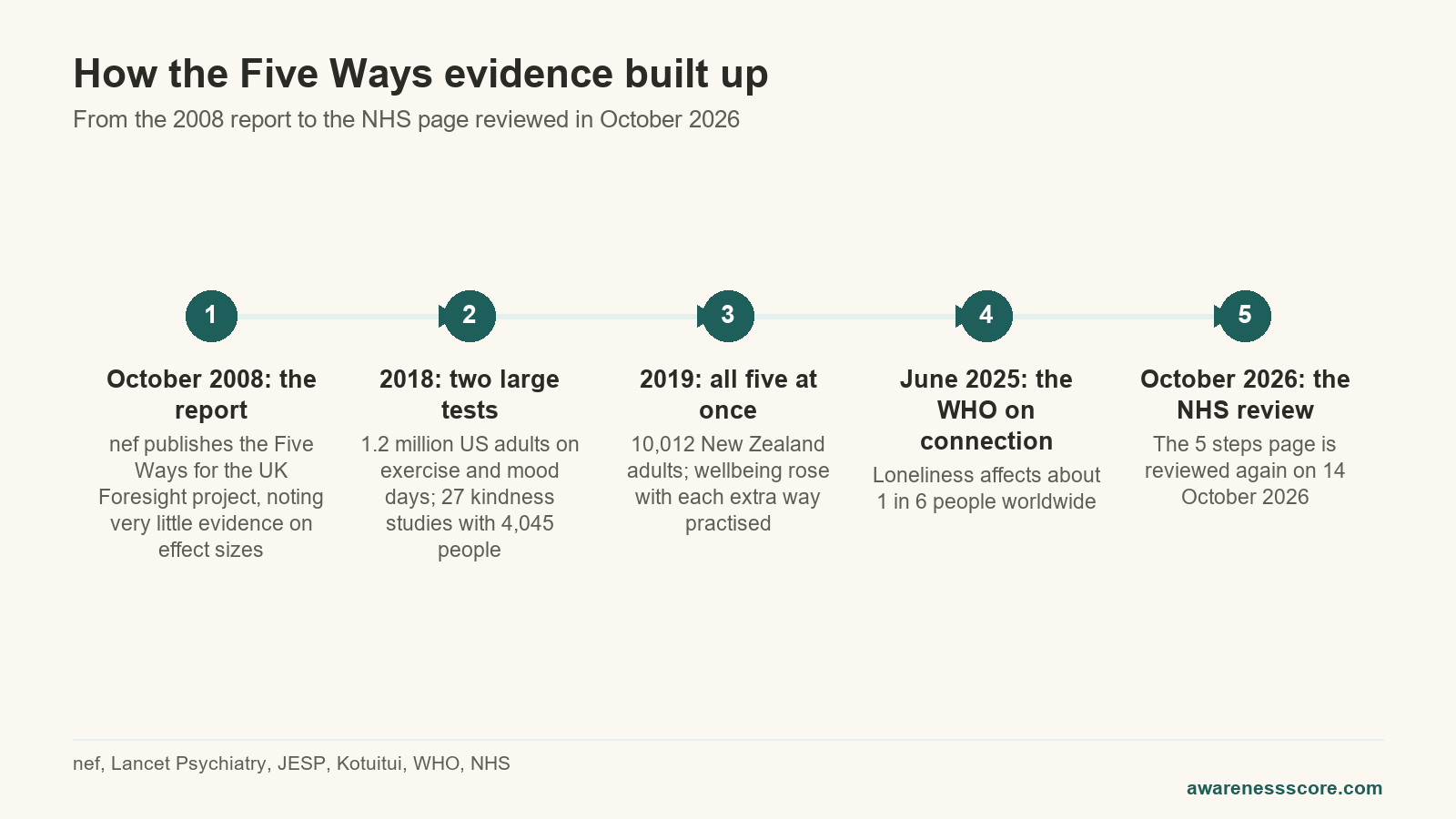
The Five Ways were written by Jody Aked, Nic Marks, Corrina Cordon and Sam Thompson at the new economics foundation (nef) and published on 22 October 2008. Their brief was unusual for a government project: turn a mountain of evidence into five actions anyone in the UK could do without money or equipment, each with everyday examples, from fixing a bike to noticing the seasons.
The NHS version, last reviewed on 14 October 2026, calls them 5 steps and renames two of them. Give became help other people, and take notice became pay attention to the present moment, with the word mindfulness in brackets. The substance is the same.
| nef 2008 wording | NHS wording, October 2026 | Examples the sources give |
|---|---|---|
| Connect | Connect with other people | Family, friends, colleagues, neighbours |
| Be active | Be physically active | Walking, cycling, gardening, dancing |
| Take notice | Pay attention to the present moment (mindfulness) | Noticing surroundings and feelings |
| Keep learning | Learn new skills | A course, an instrument, a recipe, fixing a bike |
| Give | Help other people | Thanking someone, volunteering, a small kindness |
The five ways, as nef worded them in 2008
Each item restates one of the five actions and an example from the nef report, linked on this page. Ticking them keeps a private note in your browser; it scores, screens and diagnoses nothing.
This is the report’s list, not a test. If low mood lasts more than 2 weeks, or what you are trying yourself is not helping, the NHS says to see a GP. In India, Tele-MANAS answers on 14416.
What evidence were the five ways built on?
This is the part the cheerful posters skip. The nef authors wrote that there was “very little literature, if any, on effect sizes”, so they could not say which of the five matters most or by how much. Most studies were cross sectional, a snapshot of many people at one time, which makes it hard to tell whether connecting makes people happier or happier people connect more. The table puts what the 2008 report cited beside one later study for each way.
| Way | What the 2008 report cited | One later study |
|---|---|---|
| Connect | British surveys linking a close network of three or fewer people to later common mental disorders | WHO, June 2025: loneliness affects about 1 in 6 people and is linked to an estimated 871,000 deaths a year |
| Be active | Foresight reports tying regular activity to wellbeing at all ages, with direction of cause unclear | Chekroud and colleagues, 2018: 1.2 million US adults, exercisers reported 43.2 per cent fewer poor mental health days |
| Take notice | Awareness training over 8 to 12 weeks, reported to lift wellbeing for several years | Khoury and colleagues, 2015: 29 studies, 2,668 healthy adults, mindfulness training moderately effective for stress |
| Keep learning | Adult learning correlated with life satisfaction, optimism and efficacy; one goal setting trial | Mackay and colleagues, 2019: the strongest single predictor in 10,012 New Zealand adults, beta 0.23 |
| Give | Volunteering in older people, and a weekly act of kindness over six weeks | Curry and colleagues, 2018: 27 studies, 4,045 people, a small to medium effect of 0.28 |
The right column mixes very different kinds of study, so its numbers cannot be compared with each other: a death estimate, a survey of bad days and a regression weight are different rulers.
Have later studies backed the Five Ways up?
The most direct test so far is a 2019 survey of 10,012 adults across New Zealand by Lisa Mackay and colleagues, which asked about all five ways at once and measured wellbeing on the Flourishing Scale. Wellbeing rose with each additional way people practised, a correlation of 0.53, whatever the combination. Keep learning (0.23) and take notice (0.22) were the strongest single predictors. It is cross sectional, so it shows the five travel together with higher wellbeing, not that doing them causes it.

The experiments are smaller and more modest. A 2018 meta-analysis of kindness studies pooled 27 studies with 4,045 people and found a small to medium boost to the wellbeing of the person being kind, about 0.28 standard deviations. For take notice, a 2015 review of mindfulness based stress reduction in healthy adults pooled 29 studies and 2,668 people and found the eight week course moderately effective for stress, anxiety and quality of life.
For be active, the biggest dataset is a 2018 Lancet Psychiatry study of about 1.2 million US adults. People who exercised reported 1.49 fewer days of poor mental health a month than people who did not, out of an average of 3.36, a 43.2 per cent difference. That is self report from a survey, not a trial.
Put together: the direction of the evidence has held up since 2008, and the size of the effects is honest but unspectacular. Nobody has found the brain training advert’s ten IQ points hiding in a thank you note.
What did the Five Ways leave out?
The report says plainly what it dropped and why. Nutrition was left out for three reasons: the evidence on diet and feeling good was too tangled, good food costs money and the five were meant to be free, and the UK had already been told about healthy eating many times. Nature was folded into be active and take notice rather than given its own line. Wellbeing at work was left to employers, because most of what helps there is decided by managers, not individuals.
Then there is sleep. The word does not appear anywhere in the report’s text, which every listicle that has since rediscovered sleep may find quietly satisfying. That is an omission, not a finding: sleep plainly matters, and our page on what the research says about sleep and memory covers how much. If you want to watch how your own attention and memory move with sleep and busy weeks, the free Awareness Score check-in takes about five minutes and compares you only with your own earlier scores, which also rise a little with practice and shift with time of day. It is not a medical test and cannot tell you whether any habit is working.
What do people say when the advice is just go for a walk?
The five ways read differently depending on where you start. We read three Reddit threads from 2026, about 80 replies in all. They are testimony from people writing about their own lives, not findings, and they are paraphrased here.
In an r/DecidingToBeBetter thread from September 2026 asking which small change helped wellbeing most, many top answers map onto the five: checking in on friends, a morning gym habit, five minutes of study a day, daily reading. Just as many fall outside them: enough sleep, stopping drinking, deleting social media apps.
An r/depression thread from late October 2026, with 54 comments, starts somewhere else. The writer runs for miles and still feels sad, lonely and unable to sleep. Most replies agree: several people describe years of regular exercise that did not lift what they call clinical depression, and some say it helped only when their mood was mildly low. A minority cut the other way, saying movement helps a little, or that two skipped days make things worse. One reply calls exercise a hammer: useful, but no good for a leaking pipe.

A smaller January 2026 thread has someone whose therapist suggested volunteering, and who felt too low to leave the house. The replies split between try it for an hour and find a place that does not feel like a duty.
This is where the accounts and the evidence agree. The Five Ways were designed to raise wellbeing in the general population. The 2008 report did cite exercise studies in people with depression, but the five themselves were never offered as a treatment, and none of the later studies above tested them as one.
When is low wellbeing a reason to talk to someone?
The NHS low mood page, last reviewed on 29 July 2026, says to see a GP if you have had a low mood for more than 2 weeks, if you are struggling to cope with it, or if “things you’re trying yourself are not helping”. That last line matters here. If the walks, the calls and the course are not shifting things, that is a reason to talk to a doctor, not a sign of doing wellbeing wrong. Our pages on the signs of depression the health bodies list and on the difference between a counsellor, a psychologist and a psychiatrist may help with the next step.
In India, the national Tele-MANAS helpline answers on 14416 or 1800 891 4416, free and around the clock, in many Indian languages; the Tele-MANAS service is run by the Ministry of Health and Family Welfare. In the UK, the NHS page lists where to get urgent help. If you or someone you know is in crisis, contact your local emergency number.
Frequently asked questions
Is mental wellbeing the same as mental health?
Not quite. The WHO describes mental health as a state of mental wellbeing that lets people cope, learn, work and contribute. Researchers also treat wellbeing and mental illness as partly separate, so a person can have a condition and still have good wellbeing.
Who created the Five Ways to Wellbeing?
The new economics foundation (nef), in a report by Jody Aked, Nic Marks, Corrina Cordon and Sam Thompson published on 22 October 2008 for the UK government’s Foresight Mental Capital and Wellbeing Project.
Do you have to do all five ways every day?
No. The report says the actions do not need to be practised in parallel and that variety matters, because repeating one activity can drain it of effect. A walk with a friend counts for both connect and be active.
Is there a version of the Five Ways for children?
The 2008 report aimed its five actions at all ages and cites evidence from childhood for several of them, and its examples, such as taking on a new responsibility at work, were written with UK adults in mind.
Why is sleep not one of the Five Ways?
The 2008 report does not discuss sleep at all. It explains why it left out nutrition and work, but sleep is simply absent. That says nothing about whether sleep matters; separate research shows it does.
Can the Five Ways replace therapy or medication?
No. They were designed to raise wellbeing in the general population, not to treat illness. The NHS says to see a GP if low mood lasts more than 2 weeks or the things you are trying yourself are not helping.
Finished the page? The same five questions from the top, to see what stuck.
General information from published research and public health bodies, checked on 6 November 2026. It is not medical advice, and the Awareness Score app is not a medical test. If your memory or thinking has changed noticeably, or worries you or the people close to you, talk to your doctor.
Leave a Reply