
The plain self awareness meaning is noticing yourself: your thoughts, feelings, habits and how you come across. Psychologists split it further, into private and public self awareness, reflection and rumination, and the gap between how you see yourself and how others see you. Each has its own questionnaire, and none of them is a test you pass.
Listen to this article, about 15 minutes. A synthetic voice reads the article and announces each section title as it begins; tables are read row by row and the questions at the end are left out.
Recorded 20 October 2026 from the article as published that day. Press a chapter to jump there; the highlighted line is what is playing. A play button sits beside every section heading, and once you scroll past this player a bar at the bottom of the screen keeps the controls in reach. Tap or click any sentence to hear the reading start from there.
On this page: the eight constructs psychologists keep under the one word, in a table with the item each scale asks; the five papers from 1972 to 2018 on a timeline; Eurich’s 10 to 15 per cent figure marked as the estimate it is; and what three forum threads from 2026 report.
Think you already know this? Five questions, one minute.
Every answer is on this page. Answer from what you know now; the page fills in the rest.
-
1. In Duval and Wicklund’s 1972 theory, what happens when attention turns onto the self?
Silvia and Phillips summarise the theory: self focus produces conscious self awareness and a self evaluation in which the self is compared with a standard of correctness. Silvia and Phillips, 2012 Read the section
-
2. How many items and subscales did the 1975 Self-Consciousness Scale have?
The 1975 scale has 23 items rated 0 to 4, split into private self consciousness, public self consciousness and social anxiety. Self-Consciousness Scale Read the section
-
3. How did Trapnell and Campbell’s 1999 questionnaire divide private self focus?
The Rumination-Reflection Questionnaire has 24 items in two 12 item subscales, one for the anxious circling kind of self focus and one for the curious kind. Rumination-Reflection Questionnaire Read the section
-
4. How many articles did the 2022 Carden, Jones and Passmore review include after screening?
The systematic review in the Journal of Management Education screened down to 31 articles and found self awareness, self consciousness and self knowledge overlapping in how authors define them. Carden, Jones and Passmore, 2022 Read the section
-
5. What did Eurich report in 2018 about internal and external self awareness?
Eurich’s team found the two kinds barely related, so a person can be high on one and low on the other. Harvard Business Review, 4 January 2018 Read the section
What does self awareness mean in plain English?
Start with the dictionary, because most people searching this phrase want the plain sense first. Wiktionary gives “the state or property of being self-aware; state of being aware of oneself as an individual”. That is the everyday meaning: you know you are a person with a particular set of thoughts, moods and habits, and you can notice them while they are happening rather than only afterwards.
In Hindi, dictionaries give आत्मजागरूकता (atma jagrukta) as the direct equivalent, and Wiktionary lists आत्मबोध (atmabodh) as a synonym of आत्मज्ञान, self knowledge. The two Hindi words mark a distinction the English research also makes: being aware of yourself in the moment is one thing, and the knowledge you build up about yourself over years is another.
The psychologist Alain Morin, in a 2011 review in Social and Personality Psychology Compass, describes self awareness as the ability to make yourself the focus of your own attention, during which you take in and retain information about yourself. Note the two halves: the focusing is the awareness, and the retained information is self knowledge. A person can do a great deal of the first and still get the second wrong, which is where this article is heading.
Where did the psychology of self awareness start?
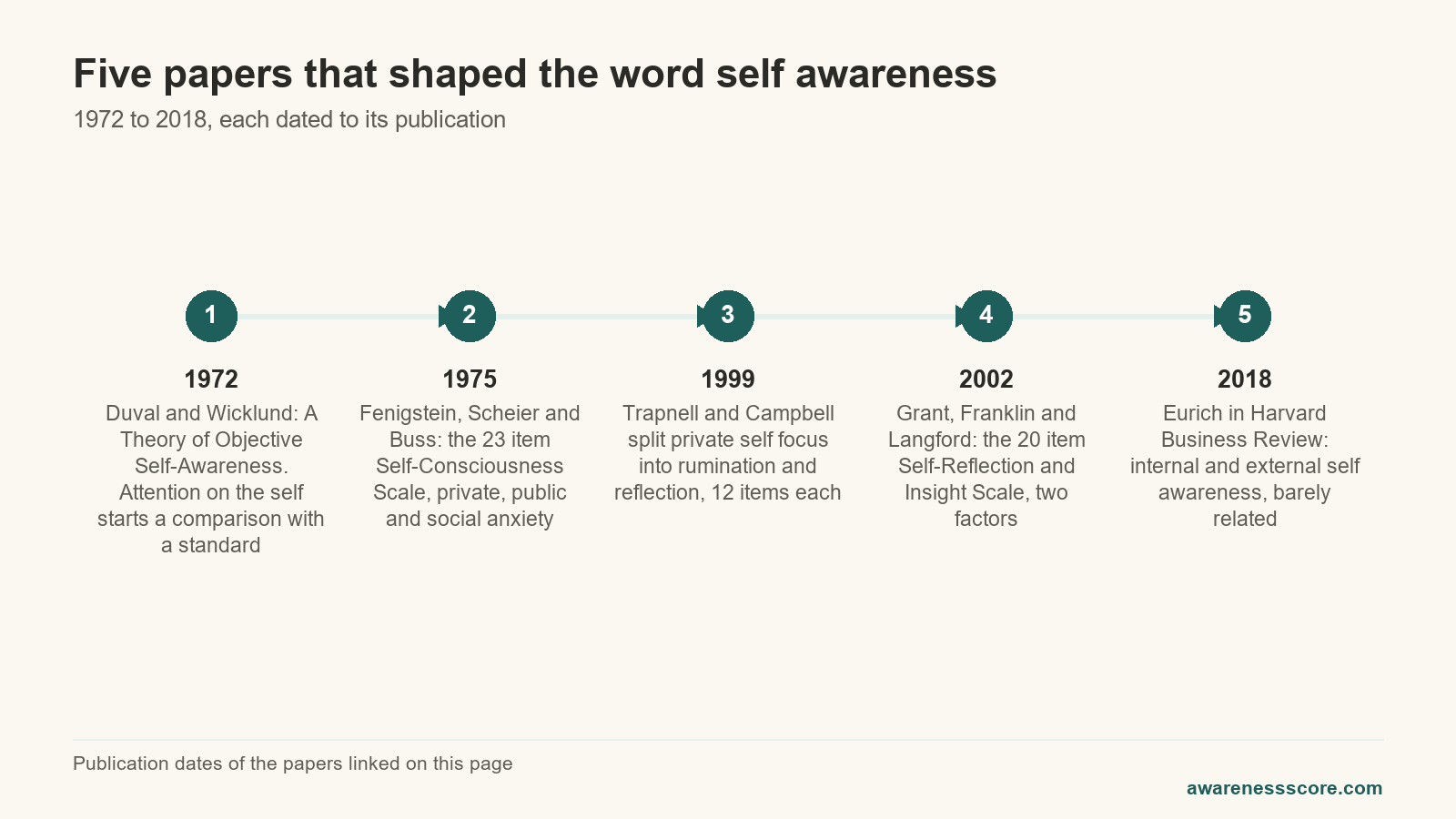
The modern research line starts in 1972 with Shelley Duval and Robert Wicklund’s book A Theory of Objective Self-Awareness. Their idea, as Silvia and Phillips summarise it in a 2012 paper in Self and Identity, is that turning attention onto yourself does two things at once: it makes you conscious of yourself, and it starts a comparison between you and a standard of correctness, some idea of how you ought to be. The discomfort you feel when a shop window catches your reflection is that comparison running.
The method matters as much as the theory. Objective self awareness was a state, switched on in the laboratory with a mirror, a video camera or an audience; in the 2012 paper’s second experiment, participants simply sat facing a large angled mirror while they worked. No questionnaire asked them anything. The original self awareness was something a room did to you, not a score you carried around.
Everything since has tried to turn that state into a trait, something a person has more or less of, and to ask what the having does to them.
What is the difference between private and public self awareness?
Three years after Duval and Wicklund, Allan Fenigstein, Michael Scheier and Arnold Buss published the Self-Consciousness Scale in the Journal of Consulting and Clinical Psychology. It has 23 items rated from 0, extremely uncharacteristic, to 4, extremely characteristic, and it split the trait into three parts. Private self consciousness is attention to the hidden side of yourself, your motives, feelings and beliefs; its sample item is “I’m always trying to figure myself out”. Public self consciousness is attention to the side others can see, your appearance and mannerisms; its sample item is “I’m concerned about my style of doing things”. Social anxiety is the apprehension that grows out of the public kind; its item is “I get embarrassed very easily”.
The word on the scale is self consciousness, not self awareness, and that is deliberate: consciousness for the stable disposition, awareness for the momentary state. Everyday English has since swapped them, so that self conscious means awkward and self aware means wise. The research never agreed to the swap. The two meanings of self consciousness, and the T shirt study that measured the gap between them, are covered in the article on self consciousness and the spotlight effect. That momentary state, and how it comes apart from attention when half a room fails to see a gorilla in the awareness meaning article, has its own page on this site. The scale was revised by Scheier and Carver in 1985 to 22 items on a four point rating, and both versions describe samples of people, not any one reader: a high private score tells you about a group’s tendency to look inward, and nothing about whether what they see is accurate.

Is self awareness the same as overthinking?
No, and the clearest evidence for that comes from a 1999 paper that set out to explain a puzzle. Private self consciousness, the figuring yourself out subscale, kept correlating with distress in some studies and with wellbeing in others. Paul Trapnell and Jennifer Campbell, writing in the Journal of Personality and Social Psychology, argued that the subscale was mixing two different motives for looking inward, and built the Rumination-Reflection Questionnaire to pull them apart: 24 items, 12 for each.
Rumination is self focus driven by threat or loss. It circles. Its items read like “I often find myself re-evaluating something I’ve done”. Reflection is self focus driven by curiosity. It wanders. Its items read like “I love exploring my inner self”. In their samples, the distress attached to rumination and the wellbeing attached to reflection. The same act, thinking about yourself, had two opposite companions depending on why you were doing it.
A second scale sharpened the point. Anthony Grant, John Franklin and Peter Langford published the Self-Reflection and Insight Scale in Social Behavior and Personality in 2002: 20 items in two factors, built on 260 undergraduates in the first study, 28 in the test retest study and 121 in the third. Self reflection, the amount of examining, correlated positively with anxiety and stress. Insight, the clarity of what the examining produced, correlated negatively with depression, anxiety and stress and positively with cognitive flexibility. Those are correlations across students, not a verdict on anyone, and the retest group was small. But the shape is the one the forum accounts below describe without having read any of it: examining yourself and understanding yourself are different quantities, and more of the first does not buy the second.
How do psychologists measure self awareness?
With questionnaires, mostly, each carving the word a little differently. The table gathers the constructs the research separates, with the kind of item each uses, so you can see what is being asked when a study reports that people “high in self awareness” did something. Items are quoted from the scale pages linked on each row.
| Construct | Who named it | What it covers | Item style | Source |
|---|---|---|---|---|
| Objective self awareness (a state) | Duval and Wicklund, 1972 | Attention turned on yourself, then compared with a standard | Not a questionnaire: induced with a mirror or a camera in the lab | Silvia and Phillips, 2012 |
| Private self consciousness (a trait) | Fenigstein, Scheier and Buss, 1975 | A habit of attending to your own feelings and motives | “I’m always trying to figure myself out” | Self-Consciousness Scale, 23 items |
| Public self consciousness | Fenigstein, Scheier and Buss, 1975 | A habit of attending to how you appear to others | “I’m concerned about my style of doing things” | Self-Consciousness Scale |
| Social anxiety | Fenigstein, Scheier and Buss, 1975 | Discomfort at being looked at or judged | “I get embarrassed very easily” | Self-Consciousness Scale |
| Rumination | Trapnell and Campbell, 1999 | Repetitive, anxious self focus that will not let go | “I often find myself re-evaluating something I’ve done” | Rumination-Reflection Questionnaire, 24 items |
| Reflection | Trapnell and Campbell, 1999 | Curious, unhurried self focus | “I love exploring my inner self” | Rumination-Reflection Questionnaire |
| Self reflection and insight | Grant, Franklin and Langford, 2002 | How much you examine yourself, and separately how clearly you understand what you find | 20 items in two factors; the two factors pull in opposite directions on anxiety | Self-Reflection and Insight Scale |
| Internal and external self awareness | Eurich, 2018 | How clearly you see your own values and impact, and how well you know how others see you | A multi rater assessment: you and the people around you both answer | Harvard Business Review, 2018 |
Notice that the only row measured by other people is the last one. Every other scale asks you to rate yourself, which is a slightly circular way to measure self awareness: a person who misjudges themselves will misjudge the questionnaire about misjudging themselves. That circularity is the subject of the next section.
Julia Carden, Rebecca Jones and Jonathan Passmore went through four decades of this literature in a 2022 systematic review in the Journal of Management Education, screening down to 31 articles. They found self awareness, self consciousness and self knowledge overlapping substantially in how authors define them, and offered a working definition built from components: awareness of your internal state, your emotions, thoughts and bodily responses, and of how your beliefs, values and motives drive your behaviour and land on other people. The review is paywalled; this summary comes from its abstract and the sources that quote it.
Why do so many people think they are self aware?
Because the measuring instrument is the thing being measured. Tasha Eurich’s team, writing in Harvard Business Review on 4 January 2018, split self awareness into an internal kind, how clearly you see your own values, reactions, strengths and effect on others, and an external kind, how well you understand the way other people see those same things. The two, she reported, were barely related: a person can be high on one and low on the other, and most people assume they are high on both.
The number everyone quotes from that work is that only 10 to 15 per cent of people are truly self aware, against about 95 per cent who believe they are. Treat it as reported rather than verified: Eurich called it an estimate, the open text of the HBR page did not carry the figure when we read it on 20 October 2026, and we found no peer reviewed paper publishing the sampling behind it. The divergence between self ratings and other people’s ratings is well supported; the percentage is a headline, not a finding.
This is also where the Instagram version belongs, the carousel that says noticing your feelings makes you emotionally advanced. By the 1975 scale that is private self consciousness; by the 1999 scale it is reflection or rumination depending on the mood you did it in; by Eurich’s split it is half the picture at most. The research is more demanding than the carousel: it counts how you look to the people who live with you.

What do people trying to become more self aware report?
We read four threads from the past year on r/mentalhealth and r/ADHD, about 45 comments in all, looking for what people say happened when they tried to understand themselves better; three carried accounts worth repeating, and a fourth, on overthinking at night, was mostly sleep tips. Everything below is what people report, paraphrased, with the thread linked. None of it is evidence about any condition, and the posters who mentioned medication or supplements are not repeated here.
In a July 2026 thread on r/mentalhealth, a poster described years of believing that overthinking every small decision meant being careful, and listed the habits that had helped them: writing thoughts down, accepting that perfection does not exist, taking one small action. The first reply cut against the tidy list: that commenter knew exactly what they should and should not be thinking about, and in harder moments still could not stop. Knowing the pattern and changing it were two different things.
An October 2026 post on the same forum, written on World Mental Health Day, said the author had once tried to control their mind by understanding it intellectually, and found that effortful watching became another trap. What they describe settling on is watching thoughts without judging them while getting on with the task in hand. A commenter said journaling helped them see fears from the outside; another admitted they wrote pages and never read them again. World Mental Health Day itself falls on 10 October every year, and the page on mental health awareness month and its dates sets it beside the May observances in the United States, Canada and the UK.
The most on topic account came from a 27 year old on r/ADHD in August 2026, who wrote that they had only just learnt how to self reflect: noticing that they interrupt people, asking why certain people push their buttons, and finding the discovery both insulting and useful. The top reply pointed them to the University of Edinburgh’s Reflection Toolkit, which lists structured models such as Gibbs’ reflective cycle and the three question “What? So what? Now what?”, on the grounds that reflection is a skill with steps rather than a mood.
Where the accounts agree with the research: they split along the line Trapnell and Campbell drew in 1999, circling described as exhausting and curiosity as a relief, and the r/ADHD poster’s leap came from noticing how they land on others, which is Eurich’s external kind. Where they differ: the research measures tendencies across samples, and the accounts describe single evenings. Nobody mentioned a questionnaire.
Reflective practices the cited research describes
These are the practices the papers and the toolkit on this page describe, as things to try. Tick the ones you have tried. Nothing is scored, nothing is interpreted, and none of it is treatment.
A list of practices described in the sources linked on this page, not a programme and not treatment. If your memory or thinking has changed in a way that worries you or the people close to you, talk to your doctor.
Can a quiz or an app tell you how self aware you are?
A six question quiz that announces your self awareness level is doing something the 23 item scale from 1975 never claimed to do, to a person who, by Eurich’s finding, is the least reliable witness on the subject. The research questionnaires compare groups in studies; they were not built to hand anyone a verdict.
For the same reason, we should be plain about what the free app at the top of this domain does and does not do. The Awareness Score check-in is four short games, about five minutes, scored from 0 to 100 against your own earlier check-ins only. It records how those four games went that day, and the number moves with sleep, stress, time of day and practice. It does not measure self awareness in any sense on this page, it does not compare you with anyone else, and it is not a diagnosis, a medical test or a medical device. If you want to watch how your own attention and reaction time move across a week, that is what it is for. If your memory or thinking has changed in a way that worries you, that is a conversation for your doctor, not a game. The retest figures behind that caution, what the four game families can and cannot tell a person, are set out in the page on what a daily cognitive check-in can tell you.
Mufy Pachorawala, who writes these pages, runs the app and also Brain Fog Remedy. The app is free and never needs the other, and nothing on either site claims to raise a score or improve self awareness. He is not a doctor or a psychologist, which is why every claim above links to someone who did the work.
Frequently asked questions
What is the self awareness meaning in Hindi?
Hindi dictionaries give आत्मजागरूकता (atma jagrukta) as the direct equivalent. आत्मबोध (atmabodh) and आत्मज्ञान (atmagyan) are the related words for self knowledge, the understanding you build up rather than the noticing in the moment.
Is self consciousness the same as self awareness?
In the research they overlap, and the 2022 Carden review found authors defining the two interchangeably. The 1975 scale used self consciousness for the stable trait. In everyday English self conscious has come to mean awkward, which the scale never intended.
What is the difference between self awareness and self knowledge?
Morin’s 2011 review separates the act of focusing attention on yourself from the information you retain about yourself. The first is awareness, the second is knowledge, and the 2002 Self-Reflection and Insight Scale found they do not rise together.
Is there a reliable self awareness test online?
The questionnaires on this page are research instruments for comparing groups, and every one except Eurich’s is a self report. A short online quiz that gives you a level is not drawn from any of them and should be read as entertainment.
Can too much self awareness be a bad thing?
The research separates two kinds of self focus. In Trapnell and Campbell’s 1999 samples, rumination went with distress and reflection with wellbeing, and in the 2002 SRIS studies the amount of self reflection correlated with anxiety while insight correlated the other way. Those describe samples, not any individual.
Does the Awareness Score app measure self awareness?
No. It is four short games that produce a 0 to 100 score compared only with your own earlier check-ins, and it moves with sleep, stress and time of day. It does not measure self awareness, screen for anything, or compare you with other people.
Finished the page? The same five questions from the top, to see what stuck.
General information from published research and public health bodies, checked on the date shown. It is not medical advice, and the Awareness Score app is not a medical test. If your memory or thinking has changed noticeably, or worries you or the people close to you, talk to your doctor.
Leave a Reply