
A daily cognitive check-in can show you how your own attention, memory and reaction time move across weeks, measured against your own earlier days. It cannot tell you how you compare with other people, whether anything is wrong, or what caused a low score. The first week mostly measures practice, and one result on its own means nothing.
Listen to this article, about 15 minutes. A synthetic voice reads the article and announces each section title as it begins; tables are read row by row and the questions at the end are left out.
Recorded 21 October 2026 from the article as published that day. Press a chapter to jump there; the highlighted line is what is playing. A play button sits beside every section heading, and once you scroll past this player a bar at the bottom of the screen keeps the controls in reach. Tap or click any sentence to hear the reading start from there.
On this page: the retest coefficients the papers report for trail making, simple reaction time and a nine test battery, drawn as one chart with each source named; the practice effect sizes from a year long study; the sleep deprivation effect size; five forum accounts from 2026; and a checklist for a fair check-in.
Think you already know this? Five questions, one minute.
Every answer is on this page. Answer from what you know now; the page fills in the rest.
-
1. In Woods and colleagues’ 2015 study, what test retest ICC did simple reaction time reach across three weekly sessions in 48 adults?
The log transformed simple reaction time scores reached an ICC of 0.83, and the session averages differed by less than 3 ms. Woods et al, 2015 Read the section
-
2. In Bartels and colleagues’ 2010 year long study of 36 healthy adults, how large were the practice effects during the frequent early sessions?
Practice effects of d 0.36 to 1.19 appeared during high frequency testing until month three, after which performance plateaued under occasional testing. Bartels et al, 2010 Read the section
-
3. Which domain showed the largest effect of short term sleep deprivation in Lim and Dinges’ 2010 meta analysis?
Lapses in simple attention gave Hedges g of 0.776, the largest of the six domains pooled from 70 articles, while reasoning accuracy was 0.125. Lim and Dinges, 2010 Read the section
-
4. In Recker and Poth’s 2023 trail making study, what range of ICCs did part B produce across the two retest intervals?
Part B ran from 0.64 to 0.82 and part A from 0.71 to 0.91 in 31 adults retested at 3 days and 34 at 10 to 30 days. Recker and Poth, 2023 Read the section
-
5. What did the five forum threads from 2026 on this page have in common?
Across the five threads the comparison was always with other people, a percentile or the poster’s own idea of their intelligence, as in the June 2026 r/lumosity thread where a first score at the 3rd percentile was read as a verdict. Read the section
The brain training advert promises ten IQ points by Friday. The six question quiz diagnoses you before the kettle boils. Between the two sits the dull, useful truth about short cognitive tests, written down in reliability papers nobody puts on a poster. This page is those papers, read on 21 October 2026, with the figures left in. The games at the root of this site are four such tests dressed up, so this is also the page the app itself needs.
Which research tests do the four games come from?
Every attention or memory game on a phone descends from a paper and pencil test, usually one older than the phone. Naming the parent matters, because the parents have had their consistency measured for decades and the children mostly have not. What every one of them measures is attention in Posner’s sense rather than awareness in the dictionary’s, a difference the article on what awareness means draws out with the gorilla experiment. The four games in the free check-in sit in four well studied families.
| Game | Research family | What the family asks you to do | A retest figure in healthy adults | Source |
|---|---|---|---|---|
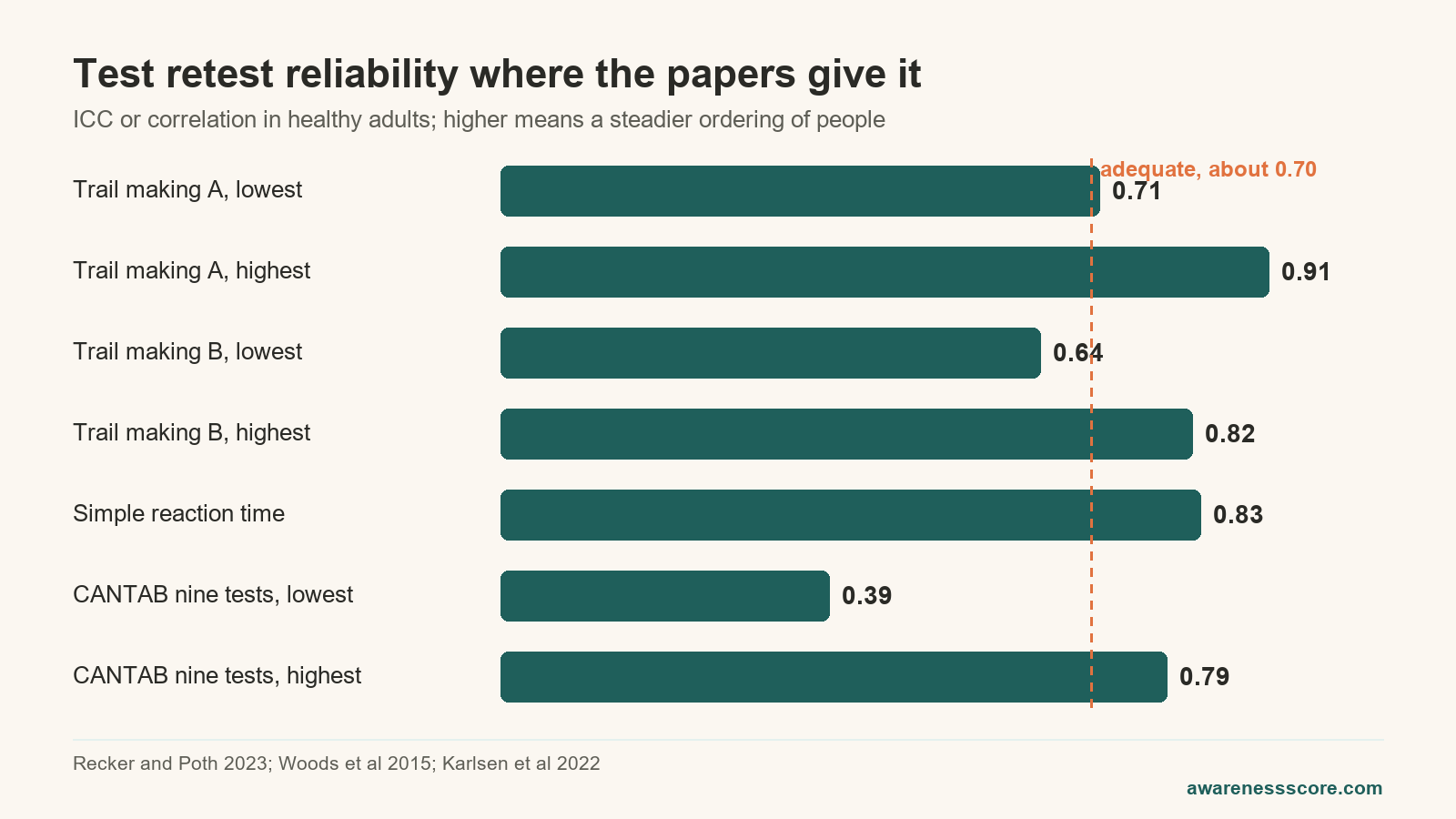
| Star Trails | Trail making (Trail Making Test, parts A and B) | Connect numbered targets in order, then alternate numbers and letters, against the clock | ICC 0.71 to 0.91 for part A and 0.64 to 0.82 for part B; 31 adults retested at 3 days and 34 at 10 to 30 days | Recker and Poth, 2023 |
| Picture Memory | Picture recognition memory | Look at a set of pictures, then say which of each pair you saw before | No figure for this test alone that I could verify. A nine test CANTAB battery that included visual memory gave correlations of 0.39 to 0.79 over three months in 75 healthy adults | Karlsen et al, 2022 |
| Grid Span | Spatial span (Corsi block tapping) | Watch squares light up in sequence and tap them back in the same order | Reported as poor in one 2017 study of repeated computerised testing in healthy young adults; the only coefficients I found, 0.70 to 0.79, come from a children’s scale | PubMed, 2017 and the 2024 Italian norms paper |
| Reaction | Simple reaction time | Tap the moment a signal appears, many times over | ICC 0.83 in 48 adults tested at weekly intervals; mean about 232 ms; session means within 3 ms of each other | Woods et al, 2015 |
The honest rows are the two half empty ones. For picture recognition and spatial span I could not find a clean healthy adult retest figure inside this article’s research budget, and the 2024 Italian norms paper on the Corsi span lists the shortage of reliability studies as a limitation of the whole paradigm. Better to show the gap than borrow a figure from a children’s intelligence scale and hope nobody checks.
How consistent are short cognitive tests from one day to the next?
The number the papers report is an intraclass correlation, ICC for short. It runs from 0 to 1 and says how well a test keeps a group of people in the same order when they take it again: at 1.0 the fastest person on Monday is the fastest on Friday, at 0 the second session is a lottery. Calamia, Markon and Tranel’s 2013 meta analysis treats about 0.70 as adequate and found most neuropsychological scores at or above it, with some memory and executive scores below.
In Recker and Poth’s 2023 study, 31 healthy adults repeated a computerised trail making test after 3 days and another 34 after 10 to 30 days. Part A came out between 0.71 and 0.91 and part B between 0.64 and 0.82, and the spread owed less to the interval than to the instruction: told to be accurate, the 10 to 30 day group scored 0.91 on part A; told to be fast, the same interval gave 0.71. For simple reaction time, Woods and colleagues in 2015 tested 48 adults, mean age 26, three times at weekly intervals and got an ICC of 0.83; the session averages differed by less than 3 ms and the typical person moved by 7.1 ms between sessions, around a mean of about 232 ms.
Then the sobering one. Karlsen and colleagues in 2022 gave 75 healthy adults nine CANTAB tests, a laboratory battery with a trained administrator, and repeated them three months later. The correlations ran from 0.39 to 0.79 and only three of the nine tests cleared the adequate line. If a clinic grade battery manages 0.39 on some scores, a phone game in a kitchen will not beat it. Read every one of those numbers as a description of a group: an ICC says how well a test orders people, and nothing about what one person’s single number means.
Why do scores rise in the first week without you getting smarter?
Because the test is teaching you the test. Calamia, Markon and Tranel’s 2012 meta analysis pooled nearly 1,600 effect sizes for the change in mean scores on repeat testing and found the size of the rise depended on the interval, the person’s age, their diagnosis and whether an alternate form was used. The rise is not intelligence arriving. It is familiarity with the layout, the rhythm and the trick of each task.
Bartels and colleagues in 2010 tested 36 healthy adults, average age about 47, seven times across a year: practice effects of d 0.36 to 1.19 appeared during the frequent early sessions through month three, then performance plateaued. Falleti and colleagues in 2006 ran a computerised battery four times at ten minute intervals in 45 adults aged 18 to 40 and found scores stabilised after the second go; a separate group of 55 showed no practice effect at one month. Not every family behaves this way: Woods’ reaction time study found no significant learning across its three sessions, while Karlsen’s CANTAB sample still improved on 6 of 14 outcomes over three months, by Hedges g of 0.15 to 0.40.
The app’s own description says scores rise a little with practice alone, and the papers agree. So the first few sessions of any check-in are a warm up, not a baseline, and the advert that credits the early climb to a sharper brain is taking a bow for the test’s own learning curve.
What moves attention and reaction time from day to day?
Three things move a short test more than most people expect, and all three can be noted before you start rather than puzzled over afterwards.
| What changed | What the evidence found | Evidence base | Source |
|---|---|---|---|
| A night without sleep (under 48 hours awake) | Lapses in simple attention: Hedges g of 0.776, the largest effect of six domains pooled; reasoning accuracy 0.125, the smallest | 70 articles, 147 cognitive tests | Lim and Dinges, 2010 |
| Time of day against your own peak | 29 of 64 studies in adults aged 18 to 45 found a synchrony effect, mostly on attention, inhibition and memory; 10 of 12 studies in older adults | 64 and 12 studies reviewed | Chauhan et al, 2025 |
| Time of day, size of the swing | Reaction time differed by 9.0 to 34.2 per cent and attention by 7.8 to 40.3 per cent across the day, depending on the task | 11 studies reviewed | diurnal variation review, 2024 |
| Caffeine before the test | Most studies that measured reaction time found no effect below 75 mg; the alertness claim was assessed favourably for products with at least 75 mg per serving | EFSA panel review of the submitted studies | EFSA, 2014 |
| Having done the test before | Effect sizes of d 0.36 to 1.19 across tests during three months of frequent repetition, then a plateau | 36 healthy adults, seven sessions in a year | Bartels et al, 2010 |
The sleep figure deserves its own sentence. Lim and Dinges’ 2010 meta analysis pooled 70 articles on short term total sleep deprivation and found the largest effect of six domains was on lapses in simple attention, Hedges g of 0.776 with a confidence interval from 0.60 to 0.96. A simple reaction task is close to a pure lapse detector, which is why a bad night shows up in that game first. Those are averages across sleep laboratory volunteers, not a prediction for anyone’s morning. Time of day is quieter but real: in the 2025 Kingston review the hour that matched a person’s own peak helped in 29 of 64 studies of younger adults. A check-in at 7 am on Monday and 11 pm on Tuesday is two different tests wearing the same name. Stress keeps a clock of its own: in a review of 113 studies it hurt recall most when it landed just before the test, which is set out in what the research says about stress and memory loss.

Does a single bad result mean anything?
On its own, no. A healthy adult’s reaction time drifts by about 7 ms between weekly sessions when nothing has changed, a short night can move the attention measure by three quarters of a standard deviation, and the hour of the day adds a swing of its own. One number sits inside all of that noise. It is not a finding and it is not a warning. The size of each of those swings, set beside the much smaller drift with age, is laid out in a guide to typical reaction time and what moves it during a day.
The smallest unit that carries any information is a trend across weeks, compared with your own earlier results under roughly the same conditions. That is why the free check-in at the root of this site gives a 0 to 100 score compared only with your own earlier check-ins, never with other people, and says plainly that it is not a diagnosis or a medical test. If you want to watch your own numbers move across a fortnight, the check-in takes about five minutes. Even a trend is a prompt to notice, not an answer, and the next section shows what happens when people forget that.
What do people who track these scores actually report?
I read five forum threads from 2026, about fifty comments in all, on the places where people post their game scores: Reddit’s r/lumosity and r/cognitiveTesting, plus one gaming community that measures reactions obsessively. What people report is testimony, not evidence, and nothing below says anything about any reader.
- On r/lumosity in June 2026, a first time player posted an opening score at the 3rd percentile and asked whether that made them dumb. Every reply said the same thing: everyone starts low and the number climbs with play. One replier in August 2026 reported starting near 600 and passing 1,600. That is the practice curve from Bartels and Falleti, described by people who have never read them.
- On r/lumosity in September 2026, someone asked long term users what had changed outside the games. A player on a 100 day streak answered honestly: a noticeable difference, probably not; better at the games with practice, certainly.
- On r/lumosity in August 2026, a player of several years posted eleven screenshots and asked how their score stacked up against the community. The one reply noted that the percentages were already on the screen. The asker wanted a comparison with people, not a number.
- On r/CompetitiveForHonor in June 2026, a new parent described a parry drill they had run for years: fifteen blocks in a row before the baby; after three months of broken sleep, a mistimed block every four or so. One commenter pushed back, saying sleep did not noticeably change their reactions and motivation did; the poster replied that in their case sleep was the only thing that had moved.
- On r/cognitiveTesting in July 2026, a first time Human Benchmark score was posted with the question whether it was any good. Replies split between people asking whether the poster understood percentiles and people posting higher scores. One late comment in August 2026 made the point the reliability literature makes: a test you can repeat in one sitting measures how long you were willing to sit there.
Where the accounts agree with the papers: scores start low and climb with repetition, and a run of short nights shows up in reaction time first. The large trials found the same practice pattern, as the review of what brain training apps actually changed over twenty years shows. Where they diverge: one person reported no sleep effect at all, and the papers describe averages that leave room for exactly that. Where they go wrong, consistently, is the comparison. In all five threads nobody compared a score with their own earlier scores under the same conditions. They compared it with strangers, with a percentile, or with a feeling about their own intelligence, which is the one reading none of these tests supports.
How do you make a daily cognitive check-in fair to yourself?
The methods sections of the papers above are, read a certain way, a list of everything a laboratory holds still so that a second score can be compared with a first. Woods tested at weekly intervals on the same equipment. Recker and Poth fixed the instruction. Lim and Dinges’ literature exists because sleep was the variable being manipulated, which makes it the one to hold still when it is not. The checklist below restates those controls as things a person can do at a kitchen table. It interprets nothing, and a check-in that fails every item is still only a game that went badly. If you want the longer version of what the word awareness means here, the self awareness article covers the psychology.

Making a daily check-in fair to yourself
Each item restates a condition the cited studies held constant. Ticking them changes nothing about what a score means; it only makes two scores comparable.
This list interprets nothing. A check-in that fails every item is still only a game that went badly, and a change that worries you is a conversation with your doctor.
When is a change worth talking to a doctor about?
A noticeable change in your memory or thinking, or one that the people close to you have noticed, is a reason to talk to your doctor, whatever any game shows and whether or not you have ever used one. The tests a doctor uses are different instruments, given under controlled conditions and read by a clinician against norms, and no app score is part of that decision in either direction. The NHS page on memory loss is a plain place to start reading. Nothing on this page, and no trend on any check-in, replaces that conversation.
Frequently asked questions
Is a daily cognitive check-in the same as a cognitive screening test?
No. A screening test is given by a clinician under controlled conditions and read against norms for your age and education. A daily check-in is a short game repeated under whatever conditions your day provides, compared only with your own earlier results. It does not screen for, detect or measure any condition.
How many check-ins does it take before the number settles?
The papers describe groups, not a rule for you. Falleti’s 2006 battery stabilised after the second session at ten minute intervals; Bartels’ 2010 sample kept improving through three months of frequent testing before it plateaued. Treat the first week or two as warm up rather than a baseline.
What time of day is best for a cognitive check-in?
The evidence supports the same time rather than a particular time. The 2025 Kingston review found better performance at the hour matching a person’s own peak in 29 of 64 studies, so a check-in that moves around the clock is comparing two different conditions.
Does coffee change a reaction time test?
EFSA’s 2014 review noted that most studies measuring reaction time found no effect below 75 mg of caffeine, and assessed the alertness claim favourably at 75 mg per serving or more. So a coffee before one check-in and none before the next is a difference worth writing down. That is a note about fairness, not advice on caffeine.
Can the Awareness Score tell me whether I have ADHD, brain fog or dementia?
No. It is four short games that give a 0 to 100 score compared only with your own earlier check-ins. It does not diagnose, screen for, detect or measure any condition, and it never compares you with other people. A change that worries you is a conversation with your doctor.
Why compare only with my own earlier results and not with other people?
Comparing with other people needs a normative sample collected under controlled conditions, like the 48 adults in Woods’ 2015 reaction time study, and someone trained to read the result. A phone game in a kitchen has neither, and the reliability figures above show how much the conditions matter. Your own earlier days are the only fair comparison a check-in can offer.
Finished the page? The same five questions from the top, to see what stuck.
General information from published research and public health bodies, checked on the date shown. It is not medical advice, and the Awareness Score app is not a medical test. If your memory or thinking has changed noticeably, or worries you or the people close to you, talk to your doctor.
Leave a Reply