
The plain awareness meaning is knowing that something is there: a sound, a feeling, a fact, a change in the room. Psychology narrows it to what gets through attention into experience, and the experiments on this page show how much does not get through. Awareness is not attention, not consciousness, not mindfulness, though it leans on all three.
Listen to this article, about 19 minutes. A synthetic voice reads the article and announces each section title as it begins; tables are read row by row and the questions at the end are left out.
Recorded 9 November 2026 from the article as published that day. Press a chapter to jump there; the highlighted line is what is playing. A play button sits beside every section heading, and once you scroll past this player a bar at the bottom of the screen keeps the controls in reach. Tap or click any sentence to hear the reading start from there.
On this page: five experiments from 1975 to 2013 in one table with each sample size, four terms side by side with the definition each source actually uses, the gorilla paper’s own 54 and 46 per cent, and what 517 forum comments report about watching the video.
Think you already know this? Five questions, one minute.
Every answer is on this page. Answer from what you know now; the page fills in the rest.
-
1. Which of these is one of the two senses Wiktionary gives for awareness?
Wiktionary gives two senses: the state or quality of being aware of something, and the level of consciousness at which sense data can be confirmed by an observer. Wiktionary Read the section
-
2. How many separable attention networks does Posner and Petersen’s model describe?
The 1990 model, revisited in the 2012 review, separates alerting, orienting and executive attention, and none of the three is awareness itself. Petersen and Posner, 2012 Read the section
-
3. In Simons and Chabris’s 1999 study, what share of the 192 observers failed to notice the unexpected event?
The paper reports that 54 per cent noticed and 46 per cent failed to notice across all conditions; 83 per cent is the radiologists’ miss rate from the 2013 study. Simons and Chabris, 1999 Read the section
-
4. In Simons and Levin’s 1998 door study, how many of the first 15 pedestrians reported noticing that their conversation partner had been swapped?
Only 7 of the 15 reported the change, and one who reported nothing unusual then claimed to have noticed when asked directly. Simons and Levin, 1998 Read the section
-
5. What did Simons’ 2010 follow up report about people who already knew the gorilla task?
The title of the 2010 paper states the result, and several commenters on the February 2026 thread report exactly that experience with the sequel. Simons, 2010 Read the section
What does awareness mean in plain English?
Start where most people searching this phrase want to start, with the dictionary. Wiktionary gives two senses: “the state or quality of being aware of something”, and, more technically, “the state or level of consciousness where sense data can be confirmed by an observer”. The first is the one you use when you say you were not aware the meeting had moved. The second is the one a doctor uses about a patient after an accident. Both are about something being present to you, rather than merely present.
The word carries a direction as well as a state. You are aware of something: the weather, a mood, a risk, a smell of gas. Awareness without an object is an unusual use, which is one reason the phrase “raise awareness” needs a cause after it to mean anything, and why a poster promising to raise your awareness in general is promising a verb without a noun. Mental health is the cause most often attached to it, with its own calendar of months, weeks and days, and the guide to when mental health awareness month falls sorts out which country marks it when.
Indian readers search this word in several languages at once, and the translations split the senses neatly. Wiktionary’s Hindi entry is जागरूकता (jagrukta), from the root for being awake, and its Tamil is விழிப்புணர்வு (vizhippunarvu), literally wakeful feeling. In Urdu, the Rekhta dictionary gives آگاہ (aagaah) as aware, acquainted with, alert, so آگاہی (aagahi) is the state of being informed or aware, while شعور (shu’ur) leans towards consciousness, sense and understanding. Three languages, and each one reaches for the word awake. That is not an accident, and the psychology below explains why.
Is awareness the same thing as attention?
No, though everyday speech treats them as twins. Attention is the selecting; awareness is what you end up with. The most used scientific map of attention comes from Michael Posner and Steven Petersen, who proposed in 1990 and revisited in a 2012 review in the Annual Review of Neuroscience that attention is not one thing but three separable networks of brain regions. A 2024 meta analysis of studies using their model summarises the three as “obtaining and maintaining the alert state (alerting network), orienting to sensory events (orienting network), and regulating thoughts and behaviors (executive network)”.
Notice that none of the three is awareness. Alerting is being ready to notice; orienting is pointing the noticing somewhere; executive attention is keeping it there against competition. Awareness is the result when the three succeed, and the gap when they do not. You can be highly alert, oriented to the road and holding your attention on the car in front, and still be unaware of the motorcycle in the next lane, which is the subject of a surprising number of forum threads further down. How quickly that readiness becomes a response, and how little it slows with age, is counted in milliseconds in this look at what a typical reaction time is and what moves it. Feeling unusually alert is a different question again, and our page on what heightened awareness can mean, from caffeine to hypervigilance sorts out the states people give that name. Attention has a body side as well: a finding cited in our page on kinesthetic awareness, the sense of where your limbs are without looking, is that piling extra attentional demands on healthy young adults made their ankle position sense worse.
This is also why the brain training advert that promises to sharpen your awareness in ten minutes a day is selling a category error. The games in such apps, including the four in the free check-in at the top of this domain, exercise alerting, orienting and holding; they measure how those went on the day. None of them can tell you what you failed to notice on the way to work, because that is precisely the thing nobody can report.

How is awareness different from consciousness and mindfulness?
Philosophers have spent a century trying to keep these words apart, and the Stanford Encyclopedia of Philosophy’s entry on consciousness lists at least six senses of consciousness alone. Two of them are defined through awareness. A creature can count as conscious when it is “not only aware but also aware that they are aware”, and a mental state can count as conscious when it is “simply a mental state one is aware of being in”. So in the philosophy, awareness is the more basic word: consciousness is built out of it, often by adding a second layer, the awareness of the awareness.
Mindfulness is narrower still, and more recent as a technical term. In 2004 Scott Bishop and nine colleagues published a proposed operational definition in Clinical Psychology: Science and Practice with two components: the self regulation of attention so that it stays on immediate experience, and a particular orientation towards that experience, one of curiosity, openness and acceptance. Mindfulness, in other words, is attention deliberately aimed at the present plus a chosen attitude towards whatever turns up. Awareness is simply what turns up.
The table gathers the four, plus self awareness, with the working definition each source actually uses and a kitchen table example. Every definition is quoted or paraphrased from the page linked in its row, and the self awareness row has its own article on this site. So does its awkward cousin: self consciousness, the feeling of being watched and the trait psychologists measure, with the T shirt study that put the gap at 46 against 23 per cent.
| Term | Source | Working definition the source uses | Everyday example |
|---|---|---|---|
| Awareness | Wiktionary | “The state or quality of being aware of something”; also “the state or level of consciousness where sense data can be confirmed by an observer” | You are aware of the kettle boiling. You were not aware of the clock ticking until you read this sentence. |
| Attention | Posner’s three network model, as a 2024 review summarises it | Three separable functions: obtaining and maintaining an alert state, orienting to sensory events, and regulating thoughts and behaviour | Counting passes in a basketball video: alert, oriented to the white shirts, suppressing everything else. |
| Consciousness | Stanford Encyclopedia of Philosophy | Several senses; the one closest to awareness is that “a conscious mental state is simply a mental state one is aware of being in” | Being awake and able to answer when asked what you were just thinking about. |
| Mindfulness | Bishop and colleagues, 2004 | Two components: regulating attention so it stays on immediate experience, and an orientation to that experience marked by curiosity, openness and acceptance | Noticing that you are irritated at the traffic, and letting the noticing be the whole event. |
| Self awareness | the research traditions on this site | Attention turned on yourself, then compared with a standard of how you ought to be | Catching your reflection in a shop window and standing a little straighter. |
Which word do you mean?
Pick a term and read the working definition the cited source gives. This is a dictionary with its sources shown; it says nothing about you.
Definitions are quoted or paraphrased from the pages linked. No option here measures, scores or interprets anything about the reader.
How much of what is in front of us do we actually notice?
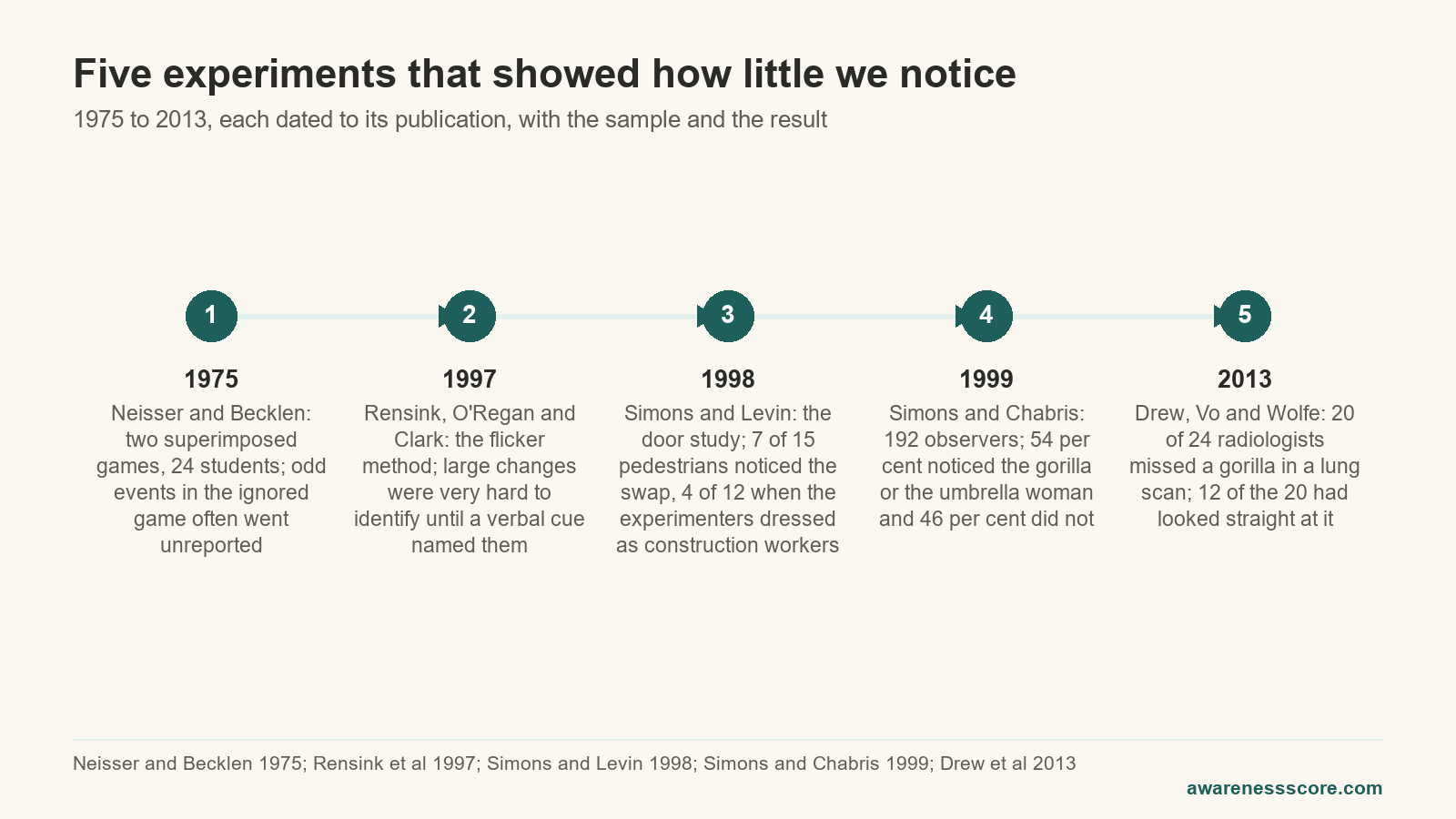
Far less than it feels like, and the experiments that showed it are among the most replicated in psychology. The feeling that you see the whole room is itself a product of attention: wherever you look, there is detail, so you conclude the detail was there all along. Five experiments between 1975 and 2013 took that feeling apart, and the table below gives each with its sample size and what it found, from the papers themselves where we could read them.
Ulric Neisser and Robert Becklen started it in 1975 by superimposing two filmed games and asking 24 Cornell students to follow one. Odd events planted in the other game, players shaking hands, fake throws, often went unreported. In 1997 Ronald Rensink, Kevin O’Regan and James Clark published the flicker method in Psychological Science: two versions of a photograph alternate, each shown for 240 milliseconds with an 80 millisecond blank between them, according to Rensink’s own abstract page. The blank swamps the little flash of motion a change would normally make, and large changes, a building moving, an engine vanishing, became “very hard to identify” even when observers were told to expect them. The moment someone named the change aloud it was obvious. The eyes were never the problem.
Then the field left the laboratory. In 1998 Daniel Simons and Daniel Levin had an experimenter stop pedestrians on a campus to ask directions. Mid conversation two men carried a door between them, and behind it the experimenter was replaced by a different man in different clothes with a different voice. The paper reports that “only 7 of the 15 pedestrians reported noticing the change of experimenters”, and that those who did were students of about the experimenters’ age. In a second run with the experimenters dressed as construction workers, so that students would see a category rather than a person, 4 of 12 noticed. The same year Arien Mack and Irvin Rock published Inattentional Blindness with MIT Press, the book that gave the phenomenon its name and argued that without attention there is no conscious perception at all.
The famous one came in 1999. Simons and Christopher Chabris, in Gorillas in Our Midst, published in Perception and indexed on PubMed, had observers count basketball passes while a woman with an umbrella or a person in a gorilla suit walked through the game for five seconds. The paper’s own words: “Out of all 192 observers across all conditions, 54% noticed the unexpected event and 46% failed to notice the unexpected event”. When the scene was filmed as one real event rather than superimposed, 67% noticed, which still leaves a third of adults who did not see a gorilla walk across a basketball court and stop to beat its chest. A harder counting task, keeping separate tallies of aerial and bounce passes, pushed noticing down from 64% to 45%. Those are population figures from a sample of mostly undergraduates: they say what a group did, and nothing about what you would do.
Expertise did not save anyone either. In 2013 Trafton Drew, Melissa Vo and Jeremy Wolfe pasted a gorilla, 48 times the size of an average nodule, into the final lung scan of a series shown to 24 radiologists searching for cancer. Twenty of the 24 did not report it, and the eye tracker showed that 12 of those 20 had looked straight at it. Wolfe’s reading, quoted at the time, was that they were looking for nodules, not gorillas. They were doing their job very well; the job was the problem.
| Year | Study | What people were asked to do | Sample | What happened |
|---|---|---|---|---|
| 1975 | Neisser and Becklen, Cognitive Psychology | Two filmed games superimposed; watch one, odd events put in the other | 24 students | Odd events in the ignored game often went unreported |
| 1997 | Rensink, O’Regan and Clark, Psychological Science | Two versions of a photograph alternate with a blank flash between them | Not stated in the abstract | Large changes became “very hard to identify” until a verbal cue named them |
| 1998 | Simons and Levin, Psychonomic Bulletin and Review | A stranger asking directions is swapped for another while a door passes between | 15, then 12 pedestrians | 7 of 15 noticed; 4 of 12 when the strangers dressed as construction workers |
| 1999 | Simons and Chabris, Perception | Count basketball passes while a gorilla or a woman with an umbrella walks through | 192 observers | 54% noticed, 46% did not; 33% missed it even when filmed as one real scene |
| 2013 | Drew, Vo and Wolfe, Psychological Science | Radiologists hunt lung nodules; a gorilla is pasted into the last scan | 24 radiologists | 20 of 24 did not report it; 12 of those 20 looked straight at it |

Can you notice something without knowing you noticed it?
Oddly, yes, and the pedestrians in the door study are the clearest case. Simons and Levin asked each one whether they had noticed anything unusual, then asked directly whether the person had changed. Most of those who had missed the swap stayed missing it when told, and were surprised. But the paper records one pedestrian “who reported noticing nothing unusual” and “nonetheless claimed to have noticed the change when asked directly”, and in the construction worker run three more did the same. Something had registered without becoming an event the person could report, until a question made it one.
The gorilla paper handled the same problem with a ladder of four questions, from “did you notice anything unusual?” to “did you see a gorilla walk across the screen?”, and found that almost nobody who failed the first question passed any of the others. For the gorilla, noticing and knowing you noticed came together or not at all. This is the distinction the Stanford entry draws between being aware and being “aware that they are aware”, and it matters for the everyday word: when someone says they were not aware a colleague was struggling, they may be telling the truth about the second layer and not the first.
It is also the honest limit of any check-in, game, quiz or app. A short test can record how fast you responded to what it showed you and how many of its items you held in mind. No test, including the free one on this domain, can measure what passed you by in the rest of the day, because the one thing a person cannot report is the thing they did not notice. Anyone selling a six question quiz that scores your awareness has quietly redefined the word to mean whatever the six questions ask.
What do people who have watched the gorilla video report?
We read 517 comments on a February 2026 r/todayilearned thread about the gorilla study, which had 986 replies in all, plus three smaller threads from 2026 where the study was being used to explain something else. Everything below is what people report, paraphrased, with the thread linked. It is testimony about one video and nothing on this page treats it as evidence about anyone’s attention, let alone a condition.
The accounts split into two camps that do not believe each other. The larger camp missed the gorilla and remembers the moment vividly: one commenter watched a documentary that revealed, at the end, a gorilla had walked through about a dozen earlier shots, sometimes stopping centre frame to wave, and had not seen it once; another got the pass count wrong and still missed it; a third says they have not trusted eyewitnesses since. The smaller camp saw it and could not accept that the others had not: a university student who saw it watched about a fifth of the class raise their hands and concluded for years afterwards that the rest were planted. One poster was accused by a basketball coach of having seen the video before, because he spotted the gorilla and spoilt the lesson.
Several in the second camp then met the sequel. More than one commenter who saw the gorilla reports being caught by a later version in which, while they congratulated themselves, a player left the court and the curtain changed colour. That version is Simons’ own 2010 follow up, Monkeying Around with the Gorillas in Our Midst, whose title gives the result: familiarity with the task did not improve detection of the other unexpected events. A parent who was fooled at university reports showing the video to their children twenty years later and watching both spot the gorilla at once, which the children, not having been told to count anything very hard, were well placed to do.
The three smaller threads show the word being put to work. On r/LearnerDriverUK in July 2026 a commenter explained a failed test’s “observation” fault as inattentional blindness, “not not paying attention, it’s that it’s engaged elsewhere”, and told the learner to watch the video rather than read about it. On r/motorcycles in October 2026 a rider asking whether motorcycles are really invisible to drivers was given the gorilla as the answer. And on r/lawofattraction, also October 2026, a poster turned the finding into a manifesting technique: rehearse an outcome nightly and you will start noticing the opportunities that were in the frame all along.
Where the accounts agree with the papers: the split between noticers and missers matches the roughly half and half of 1999, the smugness of the noticers matches the 2010 result exactly, and the drivers and riders are describing the radiologists’ problem in traffic. Where they part company: the manifesting post is right that attention decides what gets counted, and wrong, by the papers’ own logic, that it decides what is in the frame. The gorilla was there whether or not anyone counted it. Nothing on this page suggests that noticing more would have changed what walked across the court.
What does awareness mean in the name of this app?
Performance on four short games, and nothing grander. The free Awareness Score check-in at the top of this domain is Star Trails, Picture Memory, Grid Span and Reaction, about five minutes in all, producing a score from 0 to 100 that is compared only with your own earlier check-ins. In the terms of this article it exercises alerting, orienting and holding attention on a task, and it records how those went that day. The number rises a little with practice and moves with sleep, stress and the time of day, which is why the companion article on daily check-ins spends most of its length on how to compare one day with another fairly.
It is not a diagnosis, a medical test or a medical device. It does not detect, screen for or measure any condition, it does not measure awareness in the dictionary’s sense, the philosopher’s sense or the mindfulness teacher’s sense, and it does not compare you with anyone else. If your memory or thinking has changed in a way that worries you or the people close to you, that is a conversation with your doctor, and no game is a substitute for it.
Mufy Pachorawala, who writes these pages, runs the app and also Brain Fog Remedy. The app is free and never needs the other, and nothing on either site claims to raise a score or to improve awareness. He is not a doctor or a psychologist, which is why every claim above is linked to the people who did the counting.
Frequently asked questions
What is the awareness meaning in Hindi and Urdu?
Hindi dictionaries give जागरूकता (jagrukta), from the root for being awake, and Urdu uses آگاہی (aagahi) for being informed or aware, with شعور (shu’ur) carrying the wider sense of consciousness and understanding. The Tamil விழிப்புணர்வு (vizhippunarvu) also builds on the word for waking.
What is the difference between awareness and attention?
Attention is the selecting: in Posner’s model, becoming alert, orienting to something and holding it against competition. Awareness is what you end up knowing about. You can attend hard to one thing and remain unaware of another in plain view, which is what the gorilla experiment showed.
What is inattentional blindness?
The term Arien Mack and Irvin Rock gave in 1998 to failing to notice a fully visible but unexpected object because attention is engaged elsewhere. In Simons and Chabris’s 1999 study, 46 per cent of 192 observers failed to notice a gorilla or a woman with an umbrella crossing a basketball game they were watching.
What is change blindness?
Failing to notice a change between two views of a scene when the flicker of motion that would normally flag it is masked, as in Rensink’s 1997 alternating photographs, or hidden by a passing door, as in Simons and Levin’s 1998 study where 7 of 15 pedestrians noticed their conversation partner had been swapped.
Does the gorilla experiment mean half of people have poor attention?
No. The 46 per cent describes a sample of mostly undergraduates under one set of instructions, and the rate moved from 33 to 58 per cent with the display and the task. It describes a feature of human attention, not a fault in any individual, and it says nothing about any one reader.
Does the Awareness Score app measure awareness?
No. It is four short games that produce a 0 to 100 score compared only with your own earlier check-ins, and the score moves with sleep, stress, time of day and practice. It does not measure awareness in any of the senses on this page, does not screen for anything and does not compare you with other people.
Finished the page? The same five questions from the top, to see what stuck.
General information from published research and public health bodies, checked on the date shown. It is not medical advice, and the Awareness Score app is not a medical test. If your memory or thinking has changed noticeably, or worries you or the people close to you, talk to your doctor.
Leave a Reply