Anxiety attack is an everyday phrase, not a medical term: the NHS, NIMH and WHO pages on anxiety never use it. Panic attack is the defined one, a sudden rush of intense fear with physical symptoms that the NHS says usually lasts 5 to 20 minutes. People often say anxiety attack for something slower and milder.
Listen to this article, about 12 minutes. A synthetic voice reads the article and announces each section title as it begins; tables are read row by row and the questions at the end are left out.
Recorded 4 November 2026 from the article as published that day. Press a chapter to jump there; the highlighted line is what is playing. A play button sits beside every section heading, and once you scroll past this player a bar at the bottom of the screen keeps the controls in reach. Tap or click any sentence to hear the reading start from there.
On this page: the NHS, NIMH, WHO and ICD-11 wording for a panic attack set beside a phrase none of them uses, two ranking pages that give anxiety attacks durations with no source, and what 46 forum comments and one archive interview say people mean by the term.
Think you already know this? Five questions, one minute.
Every answer is on this page. Answer from what you know now; the page fills in the rest.
-
1. Which of these pages, read on 4 November 2026, uses the phrase anxiety attack?
All of them say panic attack; the phrase anxiety attack appears on none of the public health pages this article read. NHS panic disorder Read the section
-
2. What source does the Calm blog give for saying anxiety attacks range from hours to days?
The duration is stated without a source, and there is no agreed definition of anxiety attack to measure. Calm blog Read the section
-
3. How long does the NHS say most panic attacks last?
The NHS panic disorder page says most panic attacks last between 5 and 20 minutes, and some have been reported to last up to an hour. NHS panic disorder Read the section
-
4. Which of these is one of the five steps the NHS lists for during a panic attack?
The NHS lists staying where you are if possible, breathing slowly and deeply, reminding yourself it will pass, focusing on peaceful images, and remembering it is not life threatening. NHS panic disorder Read the section
-
5. In the World Mental Health Surveys of 142,949 adults, what share had ever had a panic attack?
13.2% reported a lifetime panic attack; 1.7% had lifetime panic disorder. These are population figures, not predictions about anyone. de Jonge and colleagues, 2016 Read the section
Is an anxiety attack a medical term at all?
Type the question into a search engine and the first page is mostly therapy apps and meditation brands, each with a confident table of differences. The confidence is the odd part, because the people who write the definitions do not use the phrase at all. On 4 November 2026 this site read the NHS page on panic disorder, the NHS page on anxiety, fear and panic (last reviewed 13 July 2026), the NIMH booklet on panic disorder (revised 2025) and the WHO anxiety disorders fact sheet dated 15 September 2026. The words “anxiety attack” appear on none of them. Every one says panic attack.
The WHO’s diagnostic manual follows suit. ICD-11 has a code for panic disorder, 6B01, and a separate symptom code for a panic attack, MB23.H. It has nothing called an anxiety attack. That wording was read from a coding copy of the entry, because the ICD browser will not load as text.
So anyone who says anxiety attack is not using a wrong word, just an everyday one that means whatever they mean by it. The trouble starts when a website gives that word precise durations.
How do the two terms compare, source by source?
Here are the four bodies side by side, quoted, with the link on every row. The anxiety attack column is short for a reason.
| Source or question | Panic attack, in the source’s words | Anxiety attack | Where it says so |
|---|---|---|---|
| NHS | “you regularly have sudden attacks of panic or fear” (panic disorder); “a rush of intense mental and physical symptoms” (an attack) | Not used on the page | Panic disorder, Anxiety, fear and panic |
| NIMH | “a one-time or occasional episode of intense fear with physical and emotional symptoms” | Not used on the page | Panic Disorder: When Fear Overwhelms |
| WHO | Panic disorder is “panic attacks and fear of continued panic attacks” | Not used on the page | Anxiety disorders fact sheet |
| ICD-11 (6B01) | “discrete episodes of intense fear or apprehension” with a rapid onset of several symptoms | No entry by that name | Coding copy of 6B01 |
| How fast it starts | Sudden, in all four | Not defined | As above |
| How long it lasts | NHS: “Most panic attacks last between 5 and 20 minutes”; NIMH: “a few minutes to an hour or sometimes longer” | Not defined; ranking pages give hours to days, unsourced | NHS, NIMH |
The bottom row is where the ranking pages go wrong. The Calm blog says anxiety attacks “can last for extended periods, ranging from hours to days”, and gives no source for it. A Talkspace article first published in 2019 quotes its author saying that “an extreme anxiety attack may last from a few minutes to several days”. Neither figure can be checked, because there is no agreed definition to measure. A duration for a word nobody has defined is a bit like a recommended daily allowance of vibes.
How long does a panic attack last?
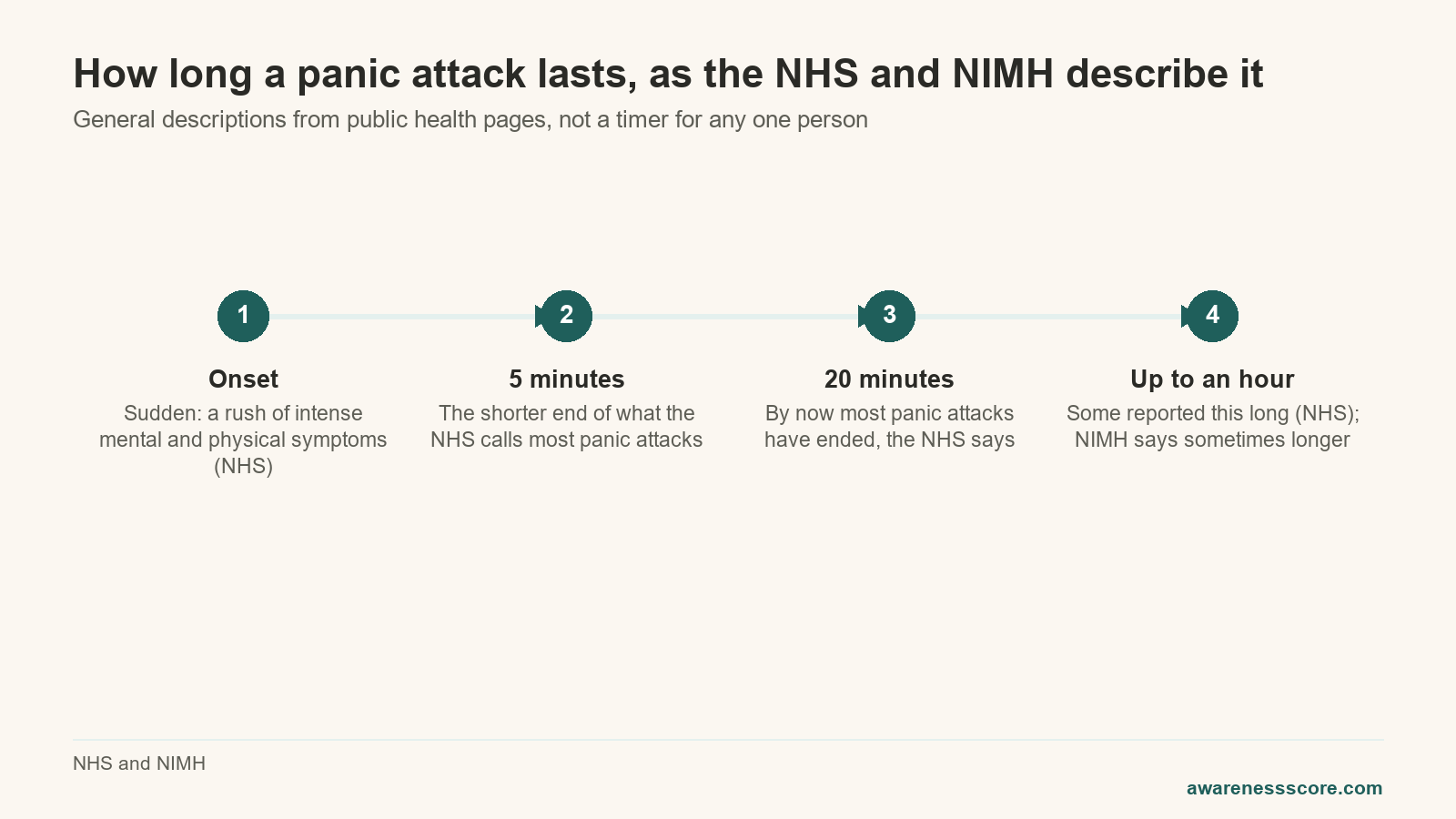
The NHS panic disorder page says “Most panic attacks last between 5 and 20 minutes. Some have been reported to last up to an hour.” Its anxiety, fear and panic page repeats that a panic attack “usually lasts 5 to 20 minutes.” NIMH is wider: “a few minutes to an hour or sometimes longer.” These describe attacks in general, not a stopwatch for any one person.
The symptoms the NHS lists for an attack are mostly physical: “a racing heartbeat”, “feeling faint”, “sweating”, “nausea”, “chest pain”, “shortness of breath”, “trembling”, “hot flushes”, “chills”, “a choking sensation”, “dizziness”, “numbness or pins and needles”, “a churning stomach” and “a feeling of dread or a fear of dying”. NIMH adds that panic attacks “often include physical symptoms that might feel like a heart attack”.
That last sentence is the important one, and it is written straight. Chest pain, breathlessness and a racing heart also have causes in the heart and lungs, and only a medical assessment can tell them apart. ICD-11 itself says the symptoms of panic disorder must not be a manifestation of another health condition. A table on a website cannot do that check.

What does the NHS say to do during a panic attack?
The NHS panic disorder page gives five things to do during an attack, in these words: “stay where you are, if possible”, “breathe slowly and deeply”, “remind yourself that the attack will pass”, “focus on positive, peaceful and relaxing images” and “remember it’s not life threatening”. The NHS anxiety, fear and panic page adds that panic attacks “can be frightening, but they’re not dangerous and should not harm you”.
Notice what the list lacks: no supplement, no app, no seven day reset. The checklist below restates it word for word.
Those steps assume it is a panic attack. If chest pain, breathlessness or collapse is new, unexplained or different from before, the NHS urgent help advice further down applies instead, and that is a call for emergency services, not a breathing exercise.
During a panic attack: the five steps the NHS lists
Each item is quoted from the NHS panic disorder page. It is a reminder of what the NHS says, not a test and not a substitute for urgent help.
From the NHS panic disorder page, read on 4 November 2026. If chest pain, breathlessness or collapse is new or unexplained, call 999 or your local emergency number, or in India Tele-MANAS on 14416. Ticking items here records nothing about you and means nothing about your health.
How common are panic attacks, and when are they panic disorder?
More common than most people guess, and far more common than the disorder. The largest study is the World Mental Health Surveys analysis by de Jonge and colleagues, published in 2016, which interviewed 142,949 adults in 25 countries. It reported that 13.2% had had a panic attack at some point in their lives. Of those, 66.5% had had more than one, and only 12.8% met the criteria for panic disorder. Lifetime panic disorder overall came to 1.7%. Those are population figures from surveys; they say nothing about any individual reader.
What turns attacks into a disorder is spelt out in the bodies’ own wording. NIMH says panic disorder “may be diagnosed when a person experiences recurrent and unexpected panic attacks”. ICD-11 adds persistent concern about the attacks coming back, or behaviour meant to avoid them, that significantly affects daily life. The WHO compresses it to “panic attacks and fear of continued panic attacks.” That is a judgement for a clinician, made in a consultation, and this page does not offer a way to make it at home.
Steady, background worry that lasts months is a different pattern in the bodies’ pages, the one they call generalised anxiety. This site’s page on the signs of anxiety the NHS, NIMH and WHO list sets those lists side by side.
What do people mean when they say anxiety attack?
If the bodies never say anxiety attack, the people saying it must mean something. To find out what, this page read three public r/Anxiety threads from 2026, 46 comments in all, plus one interview in the Oxford health experiences archive. What follows is testimony, labelled as such, and not a finding about any person, cause or treatment.
In an October 2026 thread, someone described shortness of breath, a tight stomach and a racing heart whenever a manager or a stranger spoke to them, and asked which label fitted. Of 7 replies, most said anxiety attack, and one put the folk distinction plainly: anxiety attacks build over minutes in a situation, panic attacks come from nowhere and peak in seconds. Another replied that panic attacks are anxiety too.
An August 2026 thread asked what an anxiety attack looks like, after a coworker said the poster looked fine. Of 14 comments, several said attacks often cannot be seen from outside, and others used the two terms interchangeably. In a July 2026 thread, a poster described repeated trips to urgent care fearing a heart attack or stroke; of 25 replies read, many described the same fear and the spiral of searching symptoms online, while others urged seeing a therapist or trusting the doctors’ checks.
The Oxford archive interview with Patricia, diagnosed at 23, describes going to A&E convinced she was having a heart attack, being tested and told it was a panic attack, and not being fully convinced. She says she was told attacks happen within seconds, but hers can go on for hours.
Where the accounts agree with the bodies: the racing heart, the breathlessness, the fear of dying, and the sense of something sudden. Where they differ: people use anxiety attack for the slower, situational version and keep panic attack for the overwhelming one, a split no public health page makes, and some describe attacks far longer than the 5 to 20 minutes the NHS gives.
When should a doctor check it, and where is help?
The NHS says to see a GP “if you’ve been experiencing symptoms of panic disorder”, and its anxiety page says adults in England, 18 or over and 16 or over in some areas, can refer themselves to NHS talking therapies without a GP. If you are wondering who does what once you are in that system, this site’s page on counsellors, psychologists and psychiatrists sets out the roles. Worry and attacks can also scramble memory and focus for a while, which the page on stress and memory covers from the studies.
In India, Tele-MANAS answers on 14416 or 1800 891 4416, free and round the clock, in about 20 languages; the numbers were confirmed again in reports found on 4 November 2026, and the Tele-MANAS site is the service’s own page. In the United States, NIMH lists the 988 Suicide and Crisis Lifeline by call or text on 988, and 911 in a life threatening situation. In the UK, the NHS urgent help page says to call 111 and choose the mental health option, lists Samaritans on 116 123, and says to call 999 or go to A&E in an emergency.
If attacks, chest symptoms or worry have changed in a way that troubles you or the people close to you, talk to your doctor. Nothing on this page, and no score from any app, replaces that conversation. Low mood that comes along with it has its own list, on this site’s page about the signs of depression.
Mufy Pachorawala, who writes these pages and runs the Awareness Score app, is not a doctor or a psychologist, which is why every definition above is quoted and linked to the body that published it.
Frequently asked questions
Can you have an anxiety attack without panicking?
Many people use anxiety attack for a slower, milder episode than a panic attack. Because the phrase has no medical definition, what it covers depends on who is using it.
Is a panic attack dangerous?
The NHS says panic attacks can be frightening but are not dangerous and should not harm you. Chest pain and breathlessness have other causes too, so new or unexplained symptoms need medical assessment.
Does having one panic attack mean panic disorder?
No. In the World Mental Health Surveys, 13.2% of adults had had a panic attack in their lives, and 1.7% had panic disorder. Only a clinician can make that diagnosis.
Why do panic attacks feel like a heart attack?
NIMH says panic attacks often include physical symptoms that might feel like a heart attack, such as a racing heart and chest pain. Telling the two apart needs a medical check.
Can a panic attack last for hours?
The NHS says most last 5 to 20 minutes and some have been reported to last up to an hour; NIMH says an hour or sometimes longer. Some people in public accounts describe longer episodes.
Is anxiety attack in ICD-11?
No. ICD-11 has panic disorder at 6B01 and a symptom code for panic attack, MB23.H, but no entry called anxiety attack.
Finished the page? The same five questions from the top, to see what stuck.
General information from published research and public health bodies, checked on the date shown. It is not medical advice, and the Awareness Score app is not a medical test. If your memory or thinking has changed noticeably, or worries you or the people close to you, talk to your doctor.
Leave a Reply