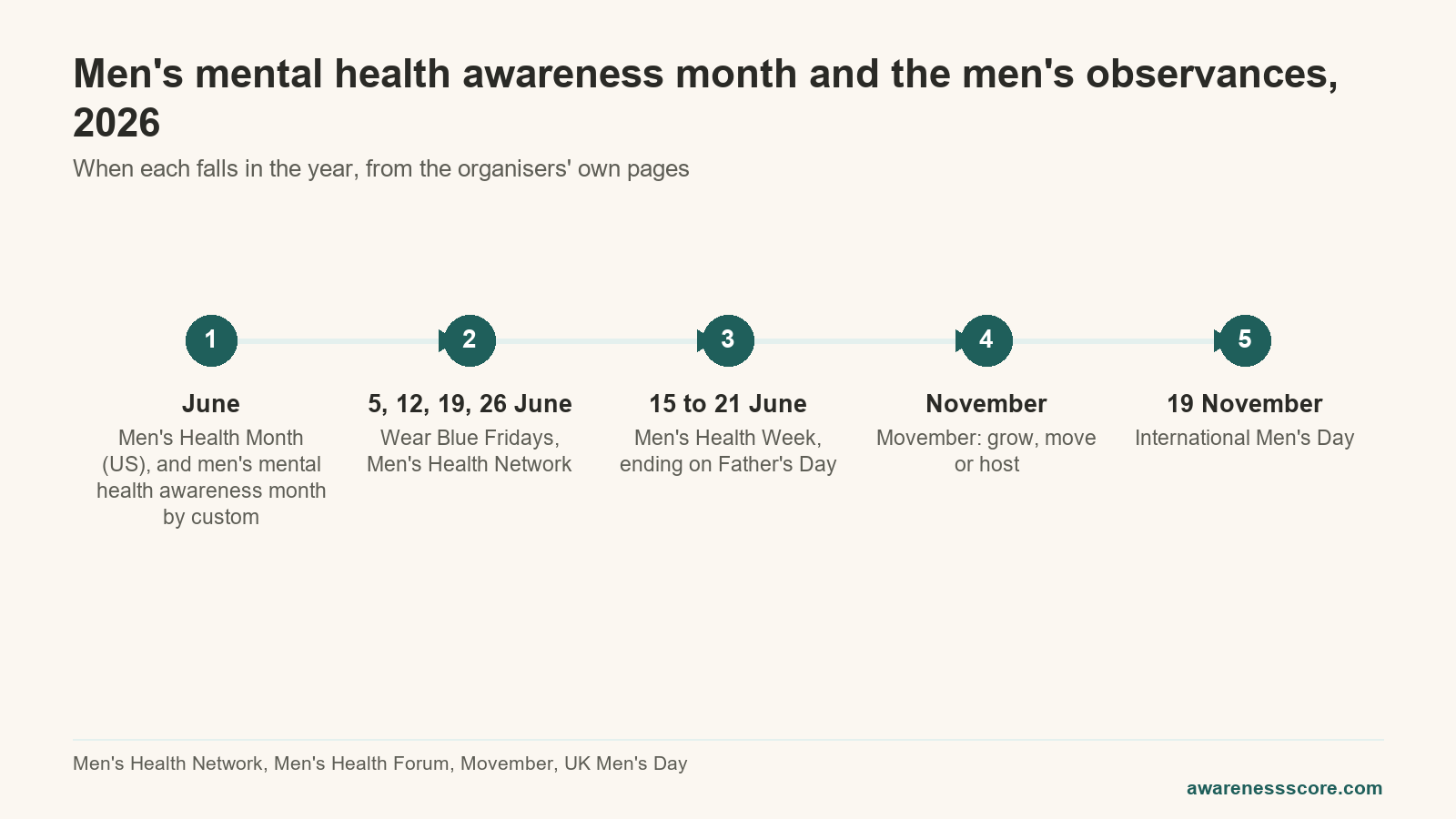
Men’s mental health awareness month is usually observed in June, alongside Men’s Health Month and Men’s Health Week, which ran from 15 to 21 June in 2026. No single official body designates the mental health version. November carries Movember and International Men’s Day on 19 November, so many campaigns treat both months as men’s season.
Listen to this article, about 13 minutes. A synthetic voice reads the article and announces each section title as it begins; tables are read row by row and the questions at the end are left out.
Recorded 2 November 2026 from the article as published that day. Press a chapter to jump there; the highlighted line is what is playing. A play button sits beside every section heading, and once you scroll past this player a bar at the bottom of the screen keeps the controls in reach. Tap or click any sentence to hear the reading start from there.
On this page: the June and November men’s observances side by side with their organisers and 2026 themes, the one day discrepancy in Men’s Health Week dates, the official suicide figures on men from the CDC, ONS and NCRB, and what three Reddit threads from 2026 said about having a month for men.
Think you already know this? Five questions, one minute.
Every answer is on this page. Answer from what you know now; the page fills in the rest.
-
1. In the Men’s Health Forum report An Unfilled Prescription, what share of UK men regularly walk through pharmacy doors?
The Forum found 92% regularly walk into a pharmacy, yet three quarters leave without discussing their health with a pharmacist. Men’s Health Forum Read the section
-
2. Where and when did Movember begin?
Movember’s own history says two friends in Melbourne started it in 2003 with 30 men, and it became a registered charity in 2006. Movember history Read the section
-
3. Which broad theme do the UK organisers of International Men’s Day use?
The UK organisers keep Supporting Men and Boys every year, with three pillars; Partners in Care is the US Men’s Health Month theme and men and pharmacy is the Men’s Health Week theme. UK Men’s Day Read the section
-
4. In England and Wales, which age group of men had the highest suicide rate in the 2025 registrations?
The ONS bulletin of 13 October 2026 gives men aged 50 to 54 the highest rate, at 28.0 per 100,000. This describes a population, not any individual. ONS Read the section
-
5. What does the C in Movember’s ALEC conversation model stand for?
ALEC, developed by the Australian charity R U OK?, stands for Ask, Listen, Encourage action and Check in. Movember Conversations Read the section
So the honest answer to “when is it?” is “which one do you mean?”, which is not the tidy reply anyone wanted. This page sorts out the June and November observances, who actually runs each one, what they asked for in 2026, and the figures the public health bodies publish on men, each checked on 27 October 2026.
When is men’s mental health awareness month?
June, in most of the places you will see it mentioned. The phrase rides on the back of an older and more official event: Men’s Health Month, which the US charity Men’s Health Network runs every June. Its 2026 material says the network founded Men’s Health Month in 1994. Searches for a separate mental health month did not turn up a founding organisation, a launch year that two sources agree on, or any government designation. Charities such as Movember and the Men’s Health Forum run June activity, and the mental health label has grown up around it by custom.
Without a parent body, nobody sets a theme, and anyone quoting “the official 2026 theme of men’s mental health month” is quoting somebody’s blog.
Who runs the June observances?
Two organisations do most of the work. In the United States, Men’s Health Month has a 2026 theme of “Partners in Care”, about family, community and caregivers helping men get better health outcomes. Its supporters wear blue on the Fridays of June, which in 2026 fell on 5, 12, 19 and 26 June.
Inside the month sits Men’s Health Week, the week that ends on Father’s Day. In 2026 the network and the UK’s Men’s Health Forum both list it as 15 to 21 June, though the menshealthmonth.org homepage itself printed 14 to 21 June when checked, one day longer than everyone else’s week. Small thing, but it is the kind of slip that ends up copied onto a thousand calendars.
The Forum picked men and pharmacy as its 2026 theme. Its report, An Unfilled Prescription, found that 92% of men in the UK regularly walk through pharmacy doors, yet three quarters of them leave without ever discussing their health with a pharmacist. The problem, it seems, is not the distance to a health professional. It is the last two metres.
What is Movember, and why November?
Movember began in Melbourne in 2003, when two friends joked about bringing the moustache back and found 30 men willing to try. In 2004 they tied it to a cause, prostate cancer first, and the Movember Foundation became a registered charity in 2006. Mental health and suicide prevention joined the list later.
The month is November, which is the whole joke of the name. On its own page, people take part by growing a moustache, moving their body or hosting a fundraising event, and the charity says it has funded more than AUD $1.8 billion of work across mental health, suicide prevention and prostate and testicular cancer. Nobody is required to look good in the moustache, which is a relief to most of the participants.
What is International Men’s Day?
International Men’s Day is a single day, 19 November, which in 2026 is a Thursday. The UK organisers keep a broad theme every year, Supporting Men and Boys, with three pillars: making a positive difference to the wellbeing of men and boys, raising awareness or funds for charities that support them, and promoting a positive conversation about men, manhood and masculinity. They say over 800 organisations take part each year and encourage events in the weeks either side.
A press release carried by a US newspaper gives the 2026 global theme as “The Future Is Everyone”. That could not be confirmed on a global organiser’s own page, so treat it with caution.
How do the men’s observances compare?
Put side by side, the confusion has a simple shape: two months, five names, and only some of them with an organiser you can point to. Each row links the page it comes from.
| Observance | When | Who runs it | 2026 theme | Source |
|---|---|---|---|---|
| Men’s Health Month | June | Men’s Health Network (US) | Partners in Care | menshealthmonth.org |
| Men’s Health Week | 15 to 21 June, ending on Father’s Day | Men’s Health Network (US); Men’s Health Forum (UK) | UK: men and pharmacy | Men’s Health Forum |
| Men’s mental health awareness month | June, by custom | No single organiser; charities and campaigns | None set | No official page found |
| Movember | November | Movember (founded Melbourne, 2003) | Grow, move or host | Movember |
| International Men’s Day | 19 November (a Thursday in 2026) | Volunteer organisers by country | UK: Supporting Men and Boys | UK Men’s Day |
If you want the general awareness month that is not about men specifically, that is May in the United States and the UK, set out in our guide to mental health awareness month, and the single worldwide day is 10 October, covered in the World Mental Health Day page.
What numbers do the public health bodies publish on men?
Most of the urgency behind these campaigns comes from one set of figures: in many countries, far more men than women die by suicide. These are population counts from official statistics. They describe countries, not any individual reader, and they say nothing about why a particular person is struggling.
| Where | What the official figures show | Source |
|---|---|---|
| Worldwide | 727,000 suicides a year, all sexes | WHO fact sheet, 28 August 2026 |
| United States, 2023 | 39,046 of 49,316 suicides were men; 22.7 per 100,000 men against 5.9 for women | CDC, NCHS Data Brief 541 |
| United States, 2024 | Male rate eased to 22.3 per 100,000 | CDC, NCHS Data Brief 572 |
| England and Wales, 2025 registrations | 6,162 suicides; 17.5 per 100,000 men against 5.5 for women | ONS, 13 October 2026 |
| India, 2024 | 1,70,746 suicides; 73.5% were men | NCRB ADSI 2024, via OpenCity |
The CDC sums up its own data as men making up 50% of the US population but nearly 80% of suicides. In England and Wales, the Office for National Statistics found the highest rate among men aged 50 to 54, at 28.0 per 100,000. Countries count differently, so the rows are not directly comparable.
On help seeking, NIMH states that men are less likely than women to have received mental health treatment in the past year, and the WHO says many people thinking of suicide are not seeking help, mainly because of stigma. That gap, more than any single number, is what the June and November campaigns are built around.
What signs do the health bodies list?
NIMH’s page on men and mental health lists common symptoms that men, their families and friends may notice. They include “anger, irritability, or aggressiveness”, “noticeable changes in mood, energy level, or appetite”, difficulty sleeping or sleeping too much, “misuse of alcohol, drugs, or both”, “engaging in high-risk activities”, aches or digestive problems without a clear cause, and thoughts of death or suicide.
Two things stand out on that list. Several items are not what people picture as low mood, such as anger and risk taking. And the list is NIMH’s description of what a doctor or mental health professional may want to hear about, not a test. Nothing on this page, or on any quiz, can tell you what a symptom means for you or anyone else. If you notice changes like these in yourself or someone close to you, talk to a doctor or a mental health professional. For everyone, not only men, the general lists are quoted side by side on this site’s page on signs of depression in the public health bodies’ own words.
What do people say about having a month for men?
Official pages explain why the months exist. Forums show how they land. For this page, three threads on Reddit’s r/mentalhealth were read, about 34 comments in all, posted between June and October 2026. These are what people chose to post, not a survey, and nothing in them is a finding.

In an October 2026 thread, a poster asked why a men’s month exists at all and whether it was a contest. Most replies answered with stigma rather than statistics: men, several said, are less likely to open up or seek help, and need more encouragement to do it. One man in his forties wrote that he now makes a point of talking openly about his own mental health, hoping it nudges one or two others. Another reply simply said it was never meant to be a competition.
A June 2026 post, written for the month itself, argued the opposite problem: that men’s struggles get waved away with “what about women?” or a reflexive “just go to therapy”. Replies mostly echoed it. One reply came from someone trying to support a father who resisted any help, asking plainly what to do, which is the question the campaigns’ conversation guides try to answer.
And a September 2026 thread about suicide prevention month made a point that fits June and November too: the posts vanish when the month ends, but nobody’s difficulties do. The most agreed reply was that a month can open the door, and the quieter check-ins afterwards matter more. One dissenter noted that people cannot think about every cause every day, which is fair, and also the whole reason calendars exist.
These accounts match the official guidance on the help seeking gap, and go beyond it on awareness with a closing date, which no organiser’s page addresses.
What do the campaigns actually ask people to do?
Less than the social posts suggest, and more specifically. Movember’s conversation guide uses a four step model, ALEC, developed by the Australian charity R U OK?: ask how someone is doing, listen without trying to fix it, encourage action, and check in afterwards. Its pages suggest asking twice, because people often say they are fine when they are not, and suggest seeing a doctor if someone has felt low for more than two weeks.
The Men’s Health Forum asks men to actually use the pharmacist they already walk past. The International Men’s Day organisers ask organisations to hold an event and list it, and Men’s Health Network asks supporters to share its toolkit and wear blue. The checklist on this page collects those requests, each from its own source.
If one of these months makes you curious about how your own focus and memory move with sleep and stress, the free Awareness Score check-in keeps a simple record: four short games, about five minutes, with a score from 0 to 100 compared only with your own earlier check-ins. Scores rise a little with practice and move with sleep, stress and the time of day, as the guide to daily check-ins explains. It is not a diagnosis, a medical test or a medical device, and it does not screen for or measure any condition.
What the men’s campaigns ask people to do
Each item restates a request on the campaign page linked in the article, plus India’s helpline. It scores, screens and diagnoses nothing.
These are the campaigns’ requests, not a test of anyone’s mental health. If your mood, memory or thinking has changed in a way that worries you or the people close to you, talk to your doctor.
Where is help if it is needed now?
If you or someone close to you needs support now, these are services the national bodies publish. In India, Tele-MANAS is on 14416 or 1-800-891-4416, free, at any hour, in many languages. In the United States, the 988 Suicide and Crisis Lifeline can be called or texted on 988, and veterans can call 988 and press 1. In the UK and Ireland, Samaritans answer on 116 123, free, day or night. If someone is in immediate danger, call your local emergency number.
If your mood, memory or thinking has changed in a way that worries you or the people close to you, talk to your doctor. A month on the calendar is a reasonable prompt to book that appointment, not a replacement for it.
Mufy Pachorawala, who writes these pages and runs the Awareness Score app, is not a doctor or a psychologist, which is why every date, theme and figure above is linked to the organisation that published it.
Frequently asked questions
Is men’s mental health awareness month in June or November?
Mostly June, by custom, alongside Men’s Health Month and Men’s Health Week. November is Movember and holds International Men’s Day on 19 November, so both months carry men’s mental health campaigns.
What colour represents men’s health month?
Blue. Men’s Health Network asks supporters to wear blue, and in 2026 it named the Fridays of June as Wear Blue days.
When is Men’s Health Week in 2027?
It is the week ending on Father’s Day, which in 2027 falls on Sunday 20 June, so expect 14 to 20 June. Check the Men’s Health Forum or Men’s Health Network pages once they publish their dates.
Is there a women’s mental health month?
Some clinics and charities promote one, but no public health body checked for this article designates it. The general Mental Health Awareness Month is May in the United States and the UK.
Do I have to grow a moustache to take part in Movember?
No. Movember’s own page lists growing a moustache, moving your body or hosting an event as ways to take part.
Can an online quiz tell me if I have depression?
No quiz or app can diagnose you. Only a qualified professional can assess you. If something worries you, talk to your doctor or call your national helpline.
Finished the page? The same five questions from the top, to see what stuck.
General information from published research and public health bodies, checked on the date shown. It is not medical advice, and the Awareness Score app is not a medical test. If your memory or thinking has changed noticeably, or worries you or the people close to you, talk to your doctor.
Leave a Reply