
Stress and memory loss are linked, but narrowly. A 2017 review of 113 studies found acute stress makes stored memories harder to recall in the moment, while stress just after learning slightly helped them stick. Long term stress is tied to weaker memory, and one small study saw attention recover a month after stress eased.
Listen to this article, about 11 minutes. A synthetic voice reads the article and announces each section title as it begins; tables are read row by row and the questions at the end are left out.
Recorded 4 November 2026 from the article as published that day. Press a chapter to jump there; the highlighted line is what is playing. A play button sits beside every section heading, and once you scroll past this player a bar at the bottom of the screen keeps the controls in reach. Tap or click any sentence to hear the reading start from there.
On this page: the effect sizes from a 2017 review of 113 stress and memory studies, sorted by when the stress hit, a chart of how big each one is, what long term studies and one recovery study found, what about 25 people with anxiety report, and a checklist of what the studies recorded alongside memory.
Think you already know this? Five questions, one minute.
Every answer is on this page. Answer from what you know now; the page fills in the rest.
-
1. Where does the NHS memory loss page place stress?
The NHS lists stress, anxiety and depression among the common and treatable causes, and says to see a GP if memory problems keep happening. NHS memory loss page Read the section
-
2. In the 2017 meta-analysis of 113 studies, what did stress shortly after learning do to later memory?
Postencoding stress slightly enhanced memory across 23 studies and 1,668 people, unless the stress happened in a different place from the learning. Shields and colleagues, 2017 Read the section
-
3. In the same review, which kind of material did stress at recall affect most?
The effect was minus 0.303 for negative items and minus 0.385 for positive ones, against minus 0.136 for neutral items. Shields and colleagues, 2017 Read the section
-
4. What kind of evidence did the 2018 Framingham cortisol analysis of 2,231 adults provide?
Higher morning cortisol went with weaker memory scores in a cross sectional analysis, which cannot show what caused what. Framingham Heart Study analysis, 2018 Read the section
-
5. What did the 2009 study of 20 adults find after a month of reduced stress?
Stress had impaired attentional control, and after a month of reduced stress the same people showed no significant differences from controls. The study measured attention, not memory. Liston, McEwen and Casey, 2009 Read the section
Can stress really cause memory loss?
Yes, in the sense most people mean when they type the question: the name that will not come, the room you walked into for no reason you can now recall. The World Health Organization defines stress as “a state of worry or mental tension caused by a difficult situation” and notes, on its page dated 30 March 2026, that when stressed “we may find it difficult to concentrate.” The NHS memory loss page goes further and lists stress, anxiety and depression among the “common and treatable” causes of memory problems.
What the research does not support is the idea that a hard month wipes the hard drive. Most of the laboratory work measures something smaller and more specific: how well people learn or recall a list of words or pictures in the minutes and hours around a stressful task, usually a mock job interview with mental arithmetic in front of unsmiling judges. That is not a great afternoon, but it is a measurable one.
Does stress hurt learning or remembering more?
The largest summary of that work is Shields and colleagues, 2017, a meta-analysis in Psychological Bulletin pooling 113 independent studies with 6,216 participants. Its main finding is that timing decides almost everything. Stress does different things to memory depending on whether it lands before learning, just after it, or at the moment of recall.
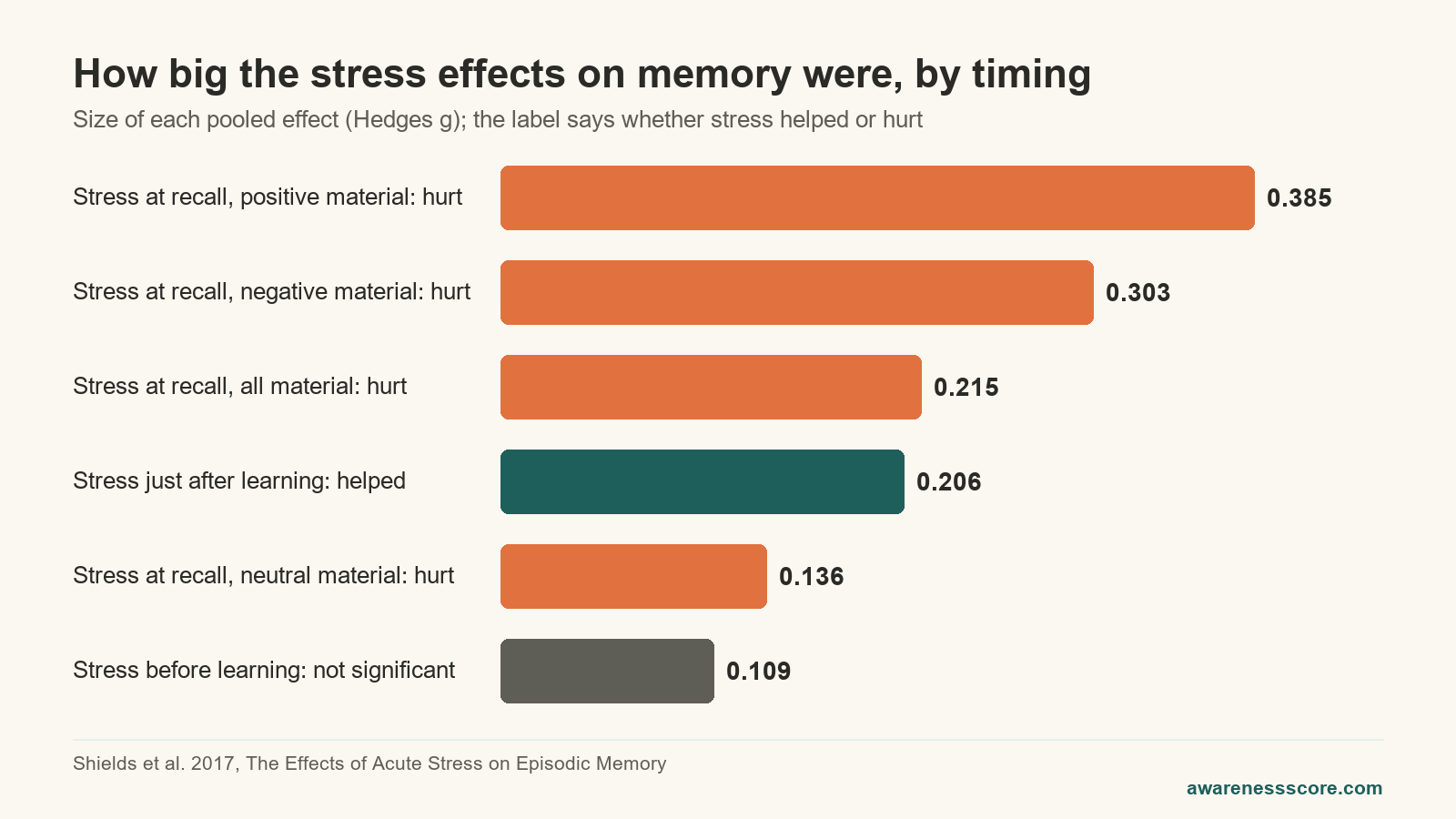
The numbers below are Hedges’ g, a standard measure of effect size where 0.2 is conventionally called small. They describe averages across groups of volunteers in laboratories, mostly young adults, and they say nothing about any one reader’s memory on any one day.
| When the stress hit | Studies and people | Pooled effect (g) | What the review found |
|---|---|---|---|
| Before or during learning | 33 studies, 1,607 people | minus 0.109 | No overall effect; impairing once learning starts about 20 minutes after the stress |
| Just after learning | 23 studies, 1,668 people | plus 0.206 | Memory slightly better, unless the stress happened somewhere else |
| Just before or during recall | 31 studies, 1,410 people | minus 0.215 | Memory worse, and consistently so across conditions |
| Recall of emotional material | Same 31 studies | minus 0.303 to minus 0.385 | Worse again for upsetting or pleasant material than for neutral (minus 0.136) |
| Spanning learning and recall | 16 studies, 1,148 people | minus 0.185 | Marginal, shrinking as the gap before the test grew |
Source for every row: Shields and colleagues, 2017, Psychological Bulletin 143(6). Two smaller groupings in the paper, stress after reactivating a memory and stress spanning consolidation and recall, showed no significant effect.
So the honest headline is that stress mostly gets in the way of retrieval, the act of finding something you already know, and the effect is small. Small is not the same as imaginary: across 1,410 people in 31 studies it held up consistently.
Why does the mind go blank under pressure?
The exam blank is the textbook case, and the review opens with it. Stress just before or during recall made memory worse in every grouping the authors tried, with low variation between studies. Emotional material suffered most: the effect was minus 0.303 for negative items and minus 0.385 for positive ones, against minus 0.136 for neutral words.
Learning has a clock on it too. When people learnt material straight after the stressor began, stress slightly helped, a non significant plus 0.186. By just over 11 minutes after stress began the effect turned negative, and at about 22 minutes it became a significant impairment. The review was careful to say these timings come from laboratory stressors, not from a week of deadlines.
One finding deserves a wider audience, mostly for the benefit of anyone selling a cortisol detox. Stress reliably raised cortisol in these studies, yet the size of the cortisol rise did not predict the size of the memory effect. The hormone is part of the story, not a dial that sets your recall.
Memory is not the only thing that slips. A companion 2016 meta-analysis by the same group found that acute stress impaired working memory, the mental notepad that holds a phone number while you dial it, and cognitive flexibility, the ability to switch between tasks.

What does long term stress do to memory?
Here the evidence gets thinner and the studies stop being experiments. Nobody can ethically assign people to years of stress, so long term findings come from following people and measuring them.
A 1998 study by Lupien and colleagues followed older adults over several years and found that those whose cortisol rose and stayed high had smaller hippocampi, the brain region most associated with forming new memories, and did worse on memory tests that depend on it. The sample was small and the participants were older, so it describes that group, not adults in general.
A much larger 2018 analysis from the Framingham Heart Study tested 2,231 dementia free adults with an average age of 48.5. Higher morning cortisol went with weaker memory and visual perception scores and with smaller total brain volume. It was a single snapshot in time, so it cannot show that cortisol caused any of it, and the authors adjusted for age, sex and vascular risk rather than ruling those out.
Put plainly: long term stress travels with poorer memory in population studies, but those studies show association, and the size of the link for any individual is not something they can estimate.
Does memory come back once the stress lifts?
The best direct test is small. Liston, McEwen and Casey, 2009 scanned 20 healthy adults after a month of psychosocial stress, confirmed on a validated rating scale. Stress selectively impaired attentional control, the ability to shift focus between rules, and weakened connections in a frontal and parietal brain network. After a month of reduced stress, the same people showed no significant differences from unstressed controls.
That study measured attention, not memory, and 20 people is a starting point rather than a conclusion. Still, it fits the laboratory pattern above: much of what stress does to recall happens around the stressful moment, and the retrieval studies measured memory minutes after the stressor, not months. Nothing in the research reviewed here supports a promise that any product, plan or app will speed that recovery.
Practice and sleep move these measures as well, which is why reaction time shifts across a single day and why a short daily check-in has real limits. The sleep side of the same question, from the laboratory studies of lost and shortened nights, is on our page about sleep and memory by the numbers. If you want to see how your own check-ins sit across a calmer week and a busier one, the free Awareness Score check-in takes about five minutes and compares only with your own earlier days. It is not a medical test and does not diagnose anything.
What the cited studies recorded alongside memory
Each item restates something the studies linked on this page measured or coded. Noting the same things makes one person’s own records easier to read back; it scores, screens and diagnoses nothing.
These are research details, not a test. If your memory keeps letting you down, or the change worries you or the people close to you, talk to your doctor.
What do people living with stress say happens to their memory?
Laboratory volunteers do not describe how a stressed week feels, so this page also read three public threads on Reddit’s r/Anxiety from 2026, about 25 replies in all. These are personal accounts, not findings, and they come from people with anxiety rather than from a representative sample. What the public health bodies themselves count as anxiety, and how many months they say it lasts, is quoted in this site’s page on the signs of anxiety the NHS, NIMH and WHO list.
In a May 2026 thread, the original poster, who said they had diagnosed anxiety conditions, described losing words mid sentence and misspelling words they knew well. Most replies agreed. One keen reader said they could barely get through a page; another said typing had started to scramble letters. One person said it had been far worse in the past and had eased since. One reply cut the other way, describing years of decline with no recovery yet.
In an October 2026 thread, someone who could not remember whether they had showered asked if anxiety worsens memory. Several replies drew the same line the research does: memory goes when agitation peaks and, as one put it, comes back once things have cooled down. Whether those peaks count as an anxiety attack or a panic attack is its own muddle, which this site\’s page comparing the two terms in the NHS, NIMH and WHO wording untangles.
In a July 2026 thread, a person a week and a half into feeling better described heavy fog and fatigue, had blood tests that came back normal, and later wrote that it had improved. Another reply described the same fog three months after the start.
Where the accounts agree with the studies is the in the moment blank. Where they go beyond them is the long, foggy tail, which the laboratory work was not designed to measure. That gap is a reason to talk to a doctor about a persistent change, not a reason to read anything into a forum.

When is forgetfulness worth raising with a doctor?
The NHS says to see a GP if you keep having problems with your memory, and gives non urgent advice to do so if memory problems are affecting your day to day life. It adds that treatment for some causes may work better if started early. Stress being a common cause does not make it the only one, and only a clinician can tell which applies.
If stress itself has become too much, India’s national Tele-MANAS helpline answers on 14416 or 1800 891 4416, free, in many Indian languages, around the clock; the Tele-MANAS service is run by the Ministry of Health and Family Welfare. Readers elsewhere can find the national services their health bodies list, and our page on Mental Health Awareness Month gathers several of them.
Frequently asked questions
Can stress cause short term memory loss?
Laboratory studies find that acute stress makes recall worse in the minutes around the stressful event and impairs working memory. The NHS lists stress and anxiety among common, treatable causes of memory problems. Persistent memory problems are a reason to see a GP.
How long does stress related memory loss last?
The laboratory effects on recall are measured within minutes to hours of the stressor. One small 2009 study of 20 adults found attention measures back to normal a month after stress eased. No study reviewed here gives a timeline for any individual.
Is cortisol what causes memory problems under stress?
Cortisol is involved, but the 2017 meta-analysis found that the size of the cortisol rise did not predict the size of the memory effect. Long term studies link higher cortisol to weaker memory without showing cause.
Does stress help memory at all?
Sometimes. In the 2017 review, stress shortly after learning improved later memory slightly, g = 0.206 across 23 studies, unless the stress happened in a different place from the learning.
Can anxiety and depression affect memory too?
The NHS lists anxiety and depression alongside stress as common and treatable causes of memory problems. This page does not cover them in detail; a GP can look at what applies to you.
Can a brain game show whether stress is affecting my memory?
No. A short game can show how your own scores move from day to day, and stress, sleep, practice and time of day all move them. It cannot identify a cause or diagnose anything; a doctor is the right person for a change that worries you.
Finished the page? The same five questions from the top, to see what stuck.
General information from published research and public health bodies, checked on 28 October 2026. It is not medical advice, and the Awareness Score app is not a medical test. If your memory or thinking has changed noticeably, or worries you or the people close to you, talk to your doctor.
Leave a Reply