
Working memory is the small mental workspace that holds a few things for a few seconds while you use them, like a phone number between the screen and the keypad. The Corsi block test measures one slice of it: how long a sequence of tapped blocks you can repeat. Healthy adults typically manage about four to six.
Listen to this article, about 11 minutes. A synthetic voice reads the article and announces each section title as it begins; tables are read row by row and the questions at the end are left out.
Recorded 10 November 2026 from the article as published that day. Press a chapter to jump there; the highlighted line is what is playing. A play button sits beside every section heading, and once you scroll past this player a bar at the bottom of the screen keeps the controls in reach. Tap or click any sentence to hear the reading start from there.
On this page: the mean Corsi block span for every decade from 20 to 89 in a 2024 study of 340 adults, a table of five span tests with the figure each study reported, the Lim and Dinges sleep loss effect sizes, and what 58 Reddit comments say about testing their own span.
Think you already know this? Five questions, one minute.
Every answer is on this page. Answer from what you know now; the page fills in the rest.
-
1. Once people cannot group items into chunks, about how many items did Cowan’s 2001 review put the central limit at?
Cowan argued that the famous seven was a rough estimate and that a central capacity limit averages about four chunks. Cowan, 2001 Read the section
-
2. In the 2024 Italian norms study, how fast did the examiner tap the blocks?
The examiner touched one cube every two seconds, and a length was passed with two of three sequences correct. Facchin and colleagues, 2024 Read the section
-
3. What was the mean forward Corsi span of the 20 to 29 age group in the 2024 study’s supplement?
The supplement reports 5.61 (SD 1.09) for 62 people in their twenties; 4.33 is the 80 to 89 group. Facchin and colleagues, supplement on OSF Read the section
-
4. In Lim and Dinges’ 2010 meta analysis, which outcome moved most after 24 to 48 hours without sleep?
Lapses in simple attention moved by minus 0.762, more than working memory accuracy at minus 0.555. Lim and Dinges, 2010 Read the section
-
5. Where do the retest figures of 0.70 to 0.79 quoted in the 2024 paper come from?
The paper cites them from a children’s scale and lists the shortage of reliability studies as a limitation of the whole paradigm. Facchin and colleagues, 2024 Read the section
What is working memory?
The psychologist Alan Baddeley, whose model of it is the one most textbooks teach, described working memory in a 1992 paper in Science as a brain system that provides temporary storage and manipulation of the information needed for complex tasks such as language comprehension, learning and reasoning. The key word is manipulation. Holding a number is short term memory; holding it while you add the tip is working memory.
It is also smaller than the internet believes. The famous figure of seven items, plus or minus two, comes from 1956. In a 2001 review in Behavioral and Brain Sciences, Nelson Cowan argued that the seven was more a rough estimate and a rhetorical device than a real limit, and that once people cannot group items into chunks, the central limit averages about four. So if eight digits fall out of your head, that is not a malfunction. That is the standard model.
What is the Corsi block test, and how is it run?
In its classic form, as Facchin and colleagues describe it in 2024, the test is a board with nine identical blocks set out irregularly. The examiner touches a sequence of them and you touch the same blocks in the same order. Sequences get longer until you fail. The longest sequence you repeat correctly is your span. Repeating it in the same order, the forward condition, is read as a measure of short term storage; repeating it backwards is read as a measure of visuospatial working memory.

It is named after Philip Corsi, who devised it for his doctoral thesis at McGill in the early 1970s; the 2024 paper says 1973, many sources say 1972. Its cousin, digit span, does the same with spoken numbers.
| Version | What you do | What the study reported | Source |
|---|---|---|---|
| Corsi blocks, forward | Watch someone tap a sequence of blocks, then tap the same blocks in the same order | Mean span 4.97 (SD 1.03) in 340 Italian adults aged 21 to 89, one block every two seconds | Facchin and colleagues, 2024 |
| Corsi blocks, forward, another standard | The same task with a different set of sequences and a faster pace | A norm of 6.2 (SD 1.3), as used by a widely sold computerised version, which taps one block a second | Inquisit manual, citing Kessels and colleagues, 2000 |
| Corsi blocks, backward | Tap the sequence back in reverse order | No harder than forward in 246 adults aged 50 to 92 | Kessels and colleagues, 2008 |
| Digit span, forward | Hear a string of digits and say it back | Mean span 6.45 (SD 1.34) in 168 Italian adults | Pasotti and colleagues, 2021 |
| Digit span, backward | Hear a string of digits and say it back in reverse | Mean span 5.02 (SD 1.5) in the same 168 adults | Pasotti and colleagues, 2021 |
Notice the two forward Corsi rows. A norm of 6.2 and a mean of 4.97 are not a contradiction about human beings. They come from different sequences, different scoring rules and different speeds: the 2024 Italian study taps one block every two seconds and needs two of three sequences right at each length, while the computerised version in the Inquisit manual gives two tries per length and stops after two failures. A span number means little until you know which test produced it.
What span is typical for adults?
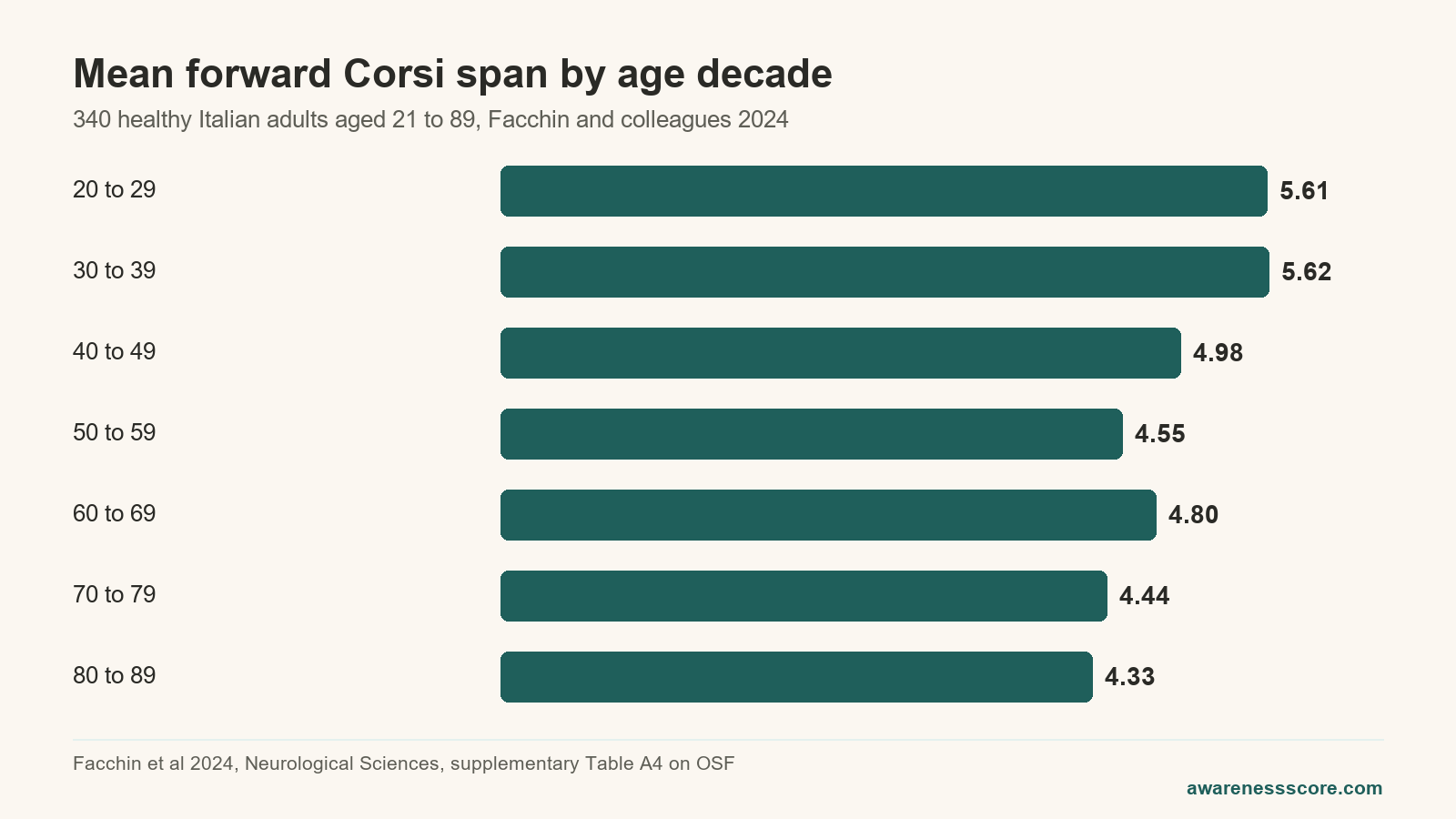
The clearest recent figures come from the supplement to the 2024 study, posted on the Open Science Framework. It reports the mean forward Corsi span for each decade of its 340 healthy adults, all screened for neurological and psychiatric history. These group averages describe that one Italian sample, not any reader.
| Age | People | Mean span | Standard deviation |
|---|---|---|---|
| 20 to 29 | 62 | 5.61 | 1.09 |
| 30 to 39 | 55 | 5.62 | 0.97 |
| 40 to 49 | 42 | 4.98 | 1.02 |
| 50 to 59 | 51 | 4.55 | 0.78 |
| 60 to 69 | 50 | 4.80 | 0.90 |
| 70 to 79 | 50 | 4.44 | 0.64 |
| 80 to 89 | 30 | 4.33 | 0.80 |
The whole sample ranged from 2 to 8 blocks. With standard deviations near one block, plenty of healthy people in every decade sat a full block either side of the average.
Does working memory span change with age?
In this sample, on average, yes. The correlation between age and Corsi span was minus 0.46, a moderate one, and the means fall from about 5.6 in the twenties and thirties to about 4.3 in the eighties. An earlier Italian study by Monaco and colleagues in 2013, of 362 adults aged 20 to 90, also found that performance fell with age on every span task it tested, forward and backward, digits and blocks.

Two cautions keep this honest. First, these are cross sectional snapshots: different people at different ages, not the same people followed for decades. Second, education did about as much work as age. Its correlation with span was 0.45, and in the 2024 sample every participant with five years of schooling or less was over 60, while nobody in the eighties group had more than 13 years. Sex made no measurable difference, with a correlation of 0.03. The bump in the sixties is a reminder that 50 people per decade is not many.
What does a short night do to working memory?
It costs something, and it is one of the better measured costs. In Lim and Dinges’ 2010 meta analysis of 70 articles and 147 cognitive tests, 24 to 48 hours without sleep lowered working memory accuracy with a combined effect size of minus 0.555 across 26 effect sizes, and slowed working memory responses by minus 0.515. Simple attention suffered more: lapses moved by minus 0.762.
Those are averages across groups kept awake in a laboratory, not a forecast for one person after one short night. Our page on what sleep loss does to memory walks through the milder cases, and the companion on stress and memory covers the other usual suspect.
What can a span test not tell you?
Quite a lot. A span test is not an intelligence test, despite the corners of the internet that convert digit spans into IQ points with the confidence of a horoscope. It does not measure long term memory, the kind that holds your childhood address. It does not diagnose, screen for or rule out any condition. And it is sensitive to strategy: chunking and practice can lift a score without the workspace itself changing.
Its reliability is also less settled than its fame suggests. The 2024 paper quotes a split half reliability of 0.75 and retest figures of 0.70 to 0.79, but those come from a children’s scale, and the authors list the insufficient number of reliability studies as a limitation of the whole paradigm. Our guide to a daily cognitive check-in found the same gap.
The Grid Span game in the free Awareness Score check-in belongs to this family: squares light up in sequence and you tap them back. It is not the Corsi test, it has no published norms, and it is not a diagnosis or a medical test. If you want to watch how your own span drifts across ordinary days, the check-in takes about five minutes and compares you only with your own earlier check-ins. Scores rise a little with practice alone and move with sleep, stress and the time of day.
The conditions the 2024 Corsi norms were collected under
Each item restates how Facchin and colleagues ran the test for their norms. It is a record of the method, useful for seeing why a home or app score is not comparable with the table, and it scores nothing about you.
Restated from the 2024 paper in Neurological Sciences, read on 10 November 2026. A span from any other procedure, including a game, cannot be read against these norms. Ticks are saved on this device only.
What do people say when they test their own span?
We read two Reddit threads from this year, 58 comments in all. They are accounts, not evidence, and nothing below is a finding about anyone’s memory.
In an r/ADHD thread from June 2026, someone who works with numbers for a living said anything past six digits simply drops out of their head, and asked whether to worry. Most of the 21 replies called this normal and repeated the seven plus or minus two figure. Several described chunking, for example reading six digits as two three digit numbers. One person said four or five digits was their limit; another said they had memorised several 16 digit numbers, which sounds like long term learning by repetition rather than span. One reply warned against general brain training apps for a specific skill, a point our page on what brain training apps can and cannot do covers from the trials.
In an r/cognitiveTesting thread from March 2026, 37 comments discussed an online digit span test taken at home. One commenter reported jumping from a scaled score of 9 to 17 or 18 within tens of minutes, after switching to a strategy built on the atomic numbers of chemical elements. Another called home span tests about the easiest thing on the internet to cheat. A third claimed to hold nine digits backwards after 25 hours awake, which cuts against the laboratory averages, though one person’s report is not a study.
Where the accounts match the research: chunking is real, and Cowan’s argument depends on it. Where they do not: the forums still treat seven as the limit, while the review puts the core nearer four, and the strategy story shows why a home score says as much about method as memory.
When is a change in memory worth raising with a doctor?
The NHS says to see a GP if you keep having problems with your memory, and if memory problems are affecting your day to day life. It adds that treatment for some causes may work better if started early.
A change in memory or thinking that worries you, or that the people close to you have noticed, is worth an appointment whatever any test or game has shown. No article, span test or app can say what it means. A short note of what you have noticed, when it started and what it affects is a useful thing to bring.
Frequently asked questions
Is working memory the same as short term memory?
Not quite. Short term memory holds information briefly. Working memory holds it and lets you work with it, such as reordering or calculating, which is why backward span tasks are often used to measure it.
Who invented the Corsi block test?
Philip Corsi, for his doctoral thesis at McGill University in the early 1970s. Sources disagree on whether the year was 1972 or 1973.
Is the backward Corsi test harder than the forward one?
Not in a 2008 study of 246 adults aged 50 to 92, which found backward Corsi no harder than forward, unlike digit span, where backward is harder.
Why do different Corsi norms give different averages?
Because versions differ in the sequences used, the tapping speed and the rule for stopping, so a span from one version cannot be compared directly with a norm from another.
Does education affect Corsi span?
In the 2024 Italian norms study, education correlated with span at 0.45, about as strongly as age did, which is why its norms correct for both.
Does a span score show whether something is wrong?
No. A span score is not a diagnosis. Anyone worried about a change in memory or thinking should talk to a doctor, whatever a test has shown.
Finished the page? The same five questions from the top, to see what stuck.
General information from published research and public health bodies, checked on 10 November 2026. It is not medical advice, and the Awareness Score app is not a medical test. If your memory or thinking has changed noticeably, or worries you or the people close to you, talk to your doctor.
Leave a Reply